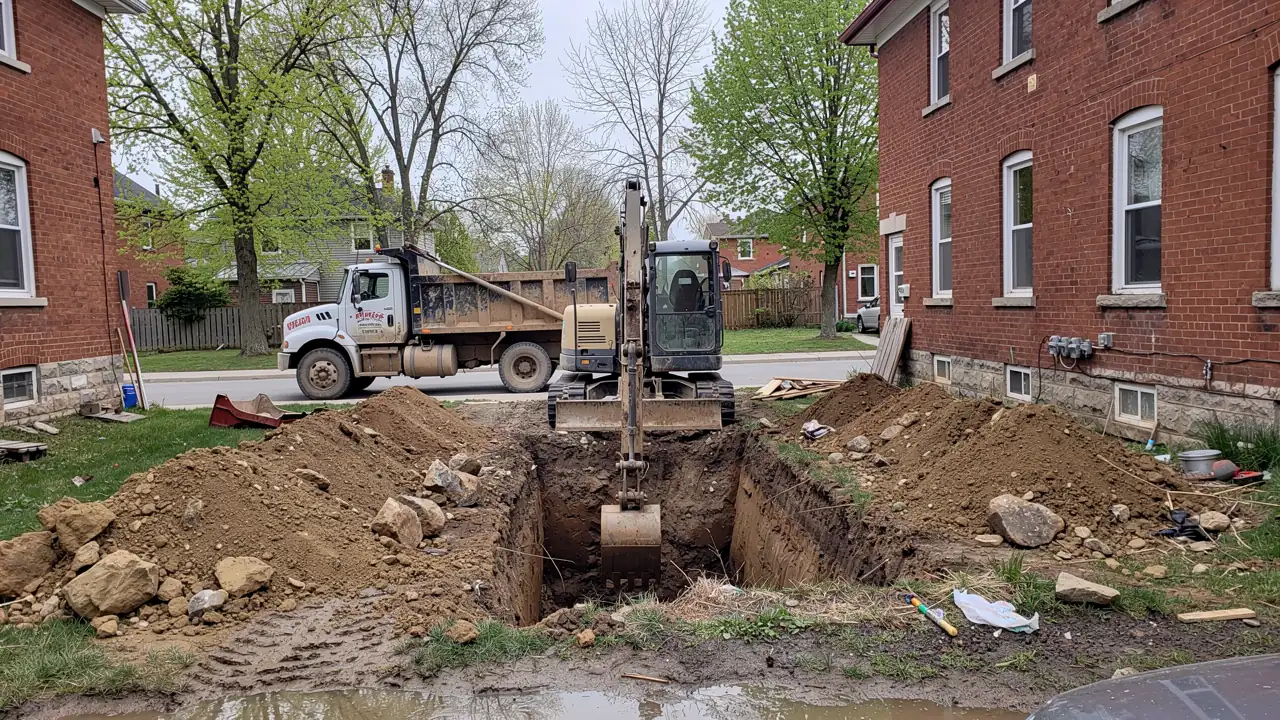
Mini excavator digging infill basement in Guelph

Excavation Services in Guelph, Ontario From a Local Crew

Guelph Excavation Pros is an excavation company in Guelph, working out of a yard on Royal Road and digging across the city for more than 10 years. Our crews have finished 500+ jobs here, from infill basements in the Ward to pools in Westminster Woods and site prep in the Hanlon Creek Business Park. We are licensed, insured and covered by WSIB.

Excavating in Guelph is a local trade. The city sits on stony glacial till and dolostone bedrock, two rivers meet in the middle of it, and almost all of its tap water is pumped from the aquifer under your lot. We plan every dig around those facts and around the City of Guelph rules on fill, trees and grading.

Homeowners, custom builders and commercial developers hire us as their excavation contractor in Guelph because we answer the phone seven days a week and quote in writing after a site visit. Once we have seen the ground, the written price is fixed, so you are not paying for guesswork.

Excavation Work We Do Across Guelph

Our Guelph excavating work falls into three patterns, and each one lines up with a part of the city. Older central neighbourhoods bring tight infill digs, the south end brings pools and walkouts on sloped lots, and the industrial parks bring larger site work.

Infill, Additions and Basement Units in Older Neighbourhoods

The Ward, Exhibition Park, St. George's Park and Old University are full of century homes on narrow lots with shared driveways and side yards under 1.5 m (5 ft). We bring a compact mini excavator through those gaps to dig footings for additions, garden suites and new basement entrances for rental units.

Many of these houses stand on rubble stone foundations laid before 1920. We expose them carefully, hand-dig the last few centimetres beside old walls and flag any undermining risk before going deeper. Our basement excavation service in Guelph covers dig-downs and new basements in detail.

Pools, Walkouts and Grading in the South End

Kortright Hills, Pine Ridge and Westminster Woods were built from the 1980s to the 2010s, and many backyards drop 1 to 3 m (3 to 10 ft) toward ravines or the Hanlon Creek valley. That fall suits walkout basements and turns pool and pond excavation into a cut-and-fill job rather than a simple hole.

Clair-Maltby, the growth area between Clair Road and Maltby Road, sits on the Paris Galt Moraine, a key groundwater recharge zone for the city. Expect strict grading and levelling requirements there as new streets go in, because the City wants rain to soak in rather than run off.

Commercial and Industrial Sites

The Northwest Industrial Park off Woodlawn Road and Elmira Road, and the Hanlon Creek Business Park beside the Hanlon Expressway, are where most of our commercial work happens. Typical scopes are topsoil stripping, building pads, storm and sanitary servicing, and parking lot subgrade.

On servicing jobs we work to the consulting engineer's drawings and the City's inspection schedule. Our site preparation and land clearing crews handle clearing, stripping and stockpiling before the structural trades arrive.

Guelph Ground Conditions

Guelph ground is mostly stony glacial till over dolostone bedrock, with wetter sand and silt along the river valleys. Each condition changes how we dig, which machine we bring and how we handle the spoil.

The city sits in the Guelph drumlin field, a landscape of low, oval till hills shaped by the last ice sheet. That is why so many Guelph streets roll up and down, and why two lots a block apart can dig very differently.

Glacial Till and Clay-Loam Soils

Most Guelph lots have 150 to 300 mm (6 to 12 in) of clay-loam topsoil over dense, stony till. Till stands well in a trench wall but drains slowly, so open footings fill with water after a storm and need pumping before concrete.

Wet till turns to paste in spring and late fall. We tarp stockpiles, keep topsoil and subsoil in separate piles and avoid tracking saturated material across lawns, where it ruts.

Dolostone Bedrock Close to the Surface

In parts of Guelph, solid rock sits within 1 to 3 m (3 to 10 ft) of the surface. It is the same grey local stone that built the Basilica of Our Lady Immaculate and much of downtown, and the rock layer geologists call the Guelph Formation is named after the city.

Shallow rock is most common along the Speed and Eramosa valleys and on higher ground in the east end. When a footing or trench hits it, we switch to a hydraulic breaker, which slows production and adds cost, so we check nearby borehole logs or dig a test pit before quoting.

Working Near the Speed and Eramosa Rivers

Lots near the two rivers, including parts of the Ward, Riverside Park and the streets around Royal City Park, have higher water tables and softer river deposits. Basements and trenches there may need dewatering with pumps set before the main dig.

Much of the land along both rivers is regulated by the Grand River Conservation Authority. Work inside floodplain or valley limits needs a GRCA permit under O. Reg. 41/24 on top of City approvals, so we check the mapping before we book machines.

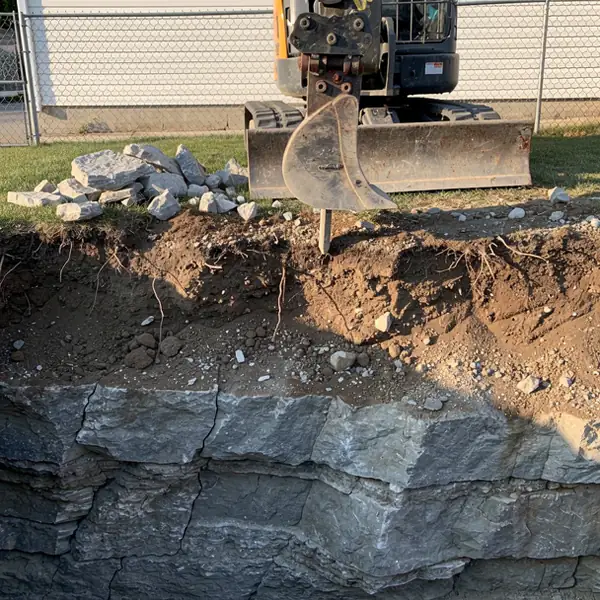
Dolostone bedrock exposed in Guelph trench

Guelph Rules That Affect Your Dig

Four City of Guelph rules shape most residential and small commercial digs: the Site Alteration By-law, the Private Tree Protection By-law, the infill grading plan requirement and source water protection. The table sums them up, and the notes below explain how each one plays out on site.

Site Alteration By-law

Guelph's Site Alteration By-law controls bringing in fill, stripping topsoil and changing grade on private land. Work done under an approved building permit or site plan is normally covered by those approvals, while a stand-alone regrade or fill job may need its own permit.

Permit or not, the new grade cannot send extra runoff onto a neighbour. We record existing elevations before we start and set new grades with a laser level.

Private Tree Protection By-law (2025)

Council updated the Private Tree Protection By-law in April 2025. It now covers trees 30 cm (12 in) in diameter or larger on private property of any size, as well as trees 10 cm or larger on lots over 0.2 ha (half an acre).

If an addition footprint or access route passes through a regulated tree or its root zone, the permit comes first. We fence tree protection zones before machines arrive and lay ground mats to spread the load over roots.

Grading and Drainage Plans for Infill Homes

The City's infill house permit checklist requires a grading and drainage plan for every new home on an existing lot. The plan shows existing and proposed elevations, swales and where roof and sump water will go.

We dig and rough-grade to that plan, then hand the finished elevations to your surveyor or engineer for sign-off. Getting it right at the dirt stage avoids a costly regrade after the sod is down.

Source Water Protection

Guelph relies almost entirely on groundwater, so the City regulates fuel, solvent and road salt handling on land around its municipal wells. In those vulnerable areas, a building permit can require a Section 59 notice or a risk management plan before it is issued.

On site we refuel machines over spill trays, carry a spill kit on every truck and never store fuel beside an open excavation. Tell us early if your property is near a City well, because it can affect the permit timeline.

City of Guelph rules for excavation work
RuleWhat it coversWhen it appliesOfficial source
Site Alteration By-law (2016)-20097Placing or dumping fill, removing topsoil, changing gradeFill and grade changes not covered by a building permit or approved planCity of Guelph Site Alteration By-law
Private Tree Protection By-law (2025)Injuring or removing trees on private landTrees 30 cm diameter or larger on any lot, and trees 10 cm or larger on lots over 0.2 haPrivate Tree Protection By-law
Infill house permit checklistGrading and drainage plan for new infill homesBuilding permit applications for a new home on an existing lotInfill house building permit checklist
Source water protectionFuel, chemical and salt handling near City wellsProperties in vulnerable areas around municipal wellsGuelph source water protection for builders

Guelph Neighbourhoods We Work In

We work in every part of Guelph, and the job mix follows the age of the houses. Use the table to see what we most often dig in your area.

AreaTypical housing eraCommon excavation jobs
Downtown and the Ward1850s to 1930s brick and stone homes, former industrial lotsInfill foundations, garden suite footings, water and sewer service replacement, rubble foundation repairs
South End: Kortright Hills, Westminster Woods, Pine Ridge, Clair-Maltby1980s to presentPools, walkouts, retaining wall bases, yard regrading, new subdivision lots
West End: Willow West, West Willow Woods, Parkwood Gardens1970s to 2000sBasement entrances, driveway widening, drainage fixes, pool removals
East End: Grange Hill East, Eastview, Victoria Road area1950s to 2010sAdditions, egress windows, sump and weeping tile digs, garage slabs
North End and industrial parks: Riverside Park, Exhibition Park edge, Northwest Industrial Park1900s to 1960s homes, 1970s onward industrialUtility trenching, parking lots, building pads, foundation waterproofing digs

Around the University of Guelph campus, many houses have been converted to student rentals. That is why basement entrance and egress window digs are so common in Old University and on the side streets off Gordon Street.

Typical Guelph Excavation Projects

These are the three job types we see most often in Guelph, with the depths, volumes and soils that are normal for each. They describe common scopes, not individual addresses.

Infill Foundation in the Ward

A full basement for a new infill home is dug 2.4 to 2.7 m (8 to 9 ft) deep and sends 250 to 400 m³ of till off site. Digging takes 2 to 4 days with a 5 to 8 t excavator and tandem trucks, and the dig and haul usually runs $15,000 to $35,000 depending on access.

Soil leaving an older urban lot is managed under O. Reg. 406/19, so the receiving site may ask for a soil sample first. We build that step into the schedule.

Fibreglass Pool Dig in the South End

A 4 x 9 m (13 x 30 ft) fibreglass pool needs about 70 to 110 m³ removed, 1.2 to 2.4 m deep, plus a level pad of clear stone. On a sloped Kortright Hills lot we often cut one side and build up the other, which can call for a short retaining wall.

Expect 1 to 2 days of digging and $4,500 to $9,000 for excavation and haul-away.

Water and Sewer Service Replacement in Older Homes

Pre-1960 homes downtown and in the north end often still have galvanized water lines or clay sewer laterals. Replacement trenches run 1.8 to 2.4 m (6 to 8 ft) deep to stay below frost, and our utility, sewer, water and storm line excavation crew usually finishes the private side in 1 to 2 days.

We are building a library of real Guelph project photos and write-ups. If you want to see a job like yours, ask at your site visit and we will share what we have from your part of the city.

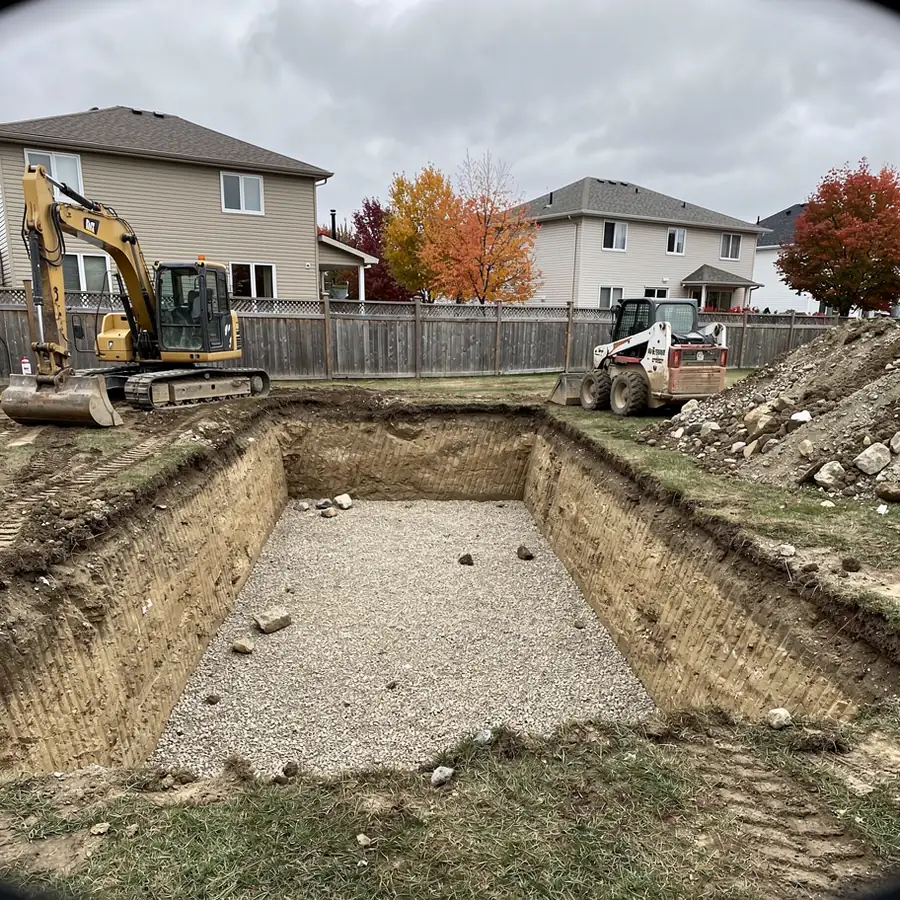
Pool dig on sloped south Guelph lot

How to Check Our Work in Guelph

The best way to judge an excavation contractor in Guelph is to check their paperwork and local feedback before you sign. Here is what we provide when you ask.

  • Our WSIB clearance certificate, current on the day you hire us
  • A certificate of insurance naming you or your builder
  • Google reviews from Guelph customers who hired Guelph Excavation Pros
  • Contact details for a past Guelph client with a similar job, where they have agreed to share them

Ask every contractor you are comparing for the same list. A crew that digs in Guelph regularly should also be able to tell you, without looking it up, whether your lot is near a City well or inside GRCA mapping.

Guelph Excavation FAQs

Do I need a permit to regrade my yard in Guelph?

Sometimes. Under the City of Guelph Site Alteration By-law, bringing in or removing fill or changing grade can need a permit when it is not part of an approved building permit or site plan.

Small landscaping touch-ups usually do not, but a regrade that moves a lot of soil or changes how water leaves your lot should be checked with the City first. We confirm the requirement before we quote and never place fill without the right paperwork.

Can I remove a tree to make room for an addition?

Only after checking the 2025 Private Tree Protection By-law. If the tree is 30 cm (12 in) or more in diameter, or 10 cm or more on a lot over 0.2 ha, you need a City permit before it is cut or its roots are damaged.

The usual steps are an arborist assessment, a permit application and any replacement planting the City requires. Start early, because the permit has to be in hand before we excavate near the tree.

Why does Guelph care so much about groundwater during digging?

Because the city's drinking water comes from wells, not a lake. Guelph draws water from municipal wells in the bedrock aquifer and from the Arkell Spring Grounds southeast of the city, so a fuel spill in a trench can reach the same water people drink.

That is why the City limits fuel and chemical storage near its wells, and why we keep spill kits on every machine. It is also why water pumped out of deep digs goes through a sediment bag before it is discharged.

How quickly can you get to a Guelph job?

Most Guelph addresses are 15 to 20 minutes from our yard on Royal Road. Site visits are usually booked within a few days, and urgent problems such as a broken water service can often be seen the same day.

We take calls Monday to Saturday from 6:00am to 9:00pm and Sunday from 9:00am to 9:00pm.

Book a Site Visit Anywhere in Guelph

Call 548-918-0387 or send the quote form, and we will set up a site visit at your Guelph property. After we see the ground, you get a written, fixed price for the dig.

  • Your street address and the nearest cross street
  • Photos of the work area and the access route from the street
  • The narrowest gate or side-yard width
  • Drawings, a site plan or a grading plan if you have one
  • Any City, GRCA or tree permit numbers already issued

Open Monday to Saturday 6:00am to 9:00pm and Sunday 9:00am to 9:00pm.

Call 548-918-0387Free Quote