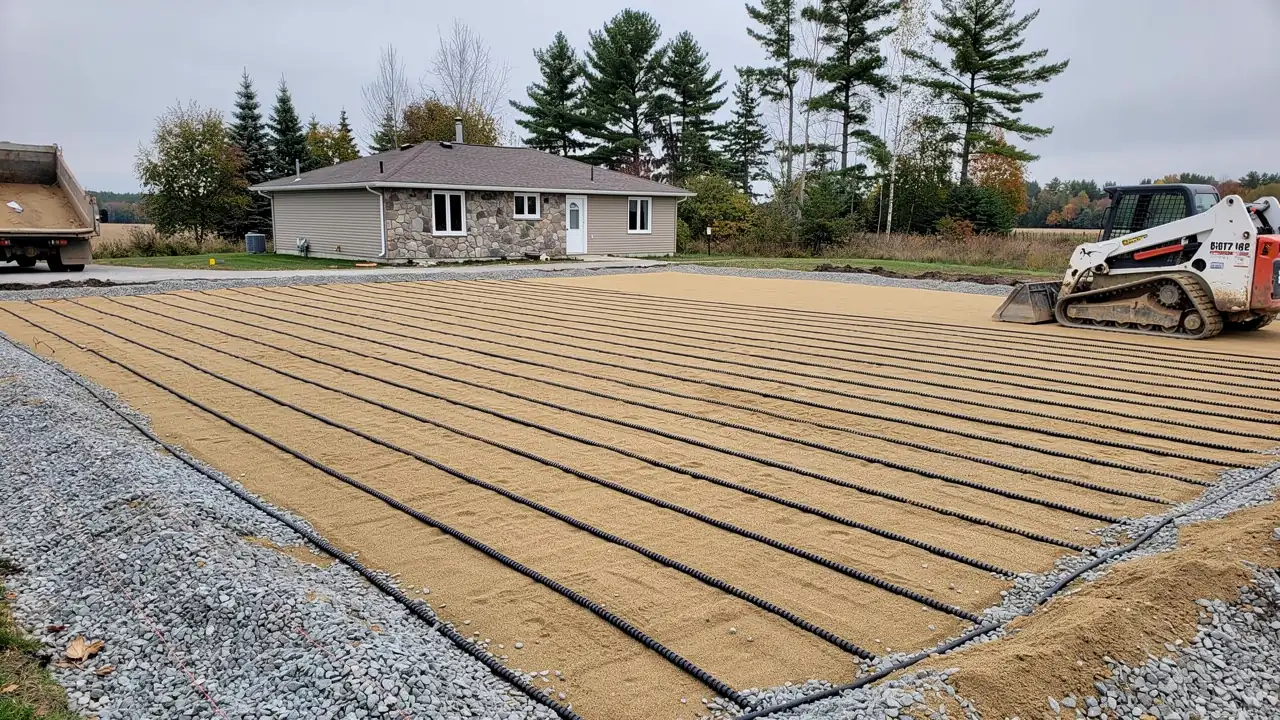
Raised septic bed under construction in Puslinch

Septic System Installation and Excavation in Guelph and Wellington County

Guelph Excavation Pros excavates and builds septic systems for rural homes across Puslinch, Guelph/Eramosa and the rest of Wellington County. Our customers are owners on private services whose bed is failing, buyers whose home inspection flagged the system, and families building new houses on country lots.

We dig the test pits, set concrete or plastic tanks, and construct conventional, raised and filter beds with imported sand and clear stone. Every system follows a permit design prepared by a BCIN-qualified designer, and the installation is carried out under a registered installer's BCIN, as Part 8 of the Ontario Building Code requires.

After 10+ years of digging in local clay, glacial till and high spring water tables, we can usually tell which lots will need a raised bed before the soil report comes back. Whether the job is a full septic system installation, a septic tank replacement or a septic bed replacement, we leave the leaching bed inspected, graded and seeded.

Septic Excavation Services We Provide

We handle four types of septic work, from a complete system on a vacant lot to a quick dig that uncovers a buried tank lid. Each one is sized and permitted under Part 8 before excavation starts.

New Septic System Installation

A new rural home needs a septic tank to settle solids and a leaching bed to treat and disperse the effluent into the soil. We excavate for both, set the tank, build the bed to the permit drawings and run the building sewer from the house.

On new builds we often handle the foundation excavation as well, then schedule the septic after backfill so no truck crosses a finished bed.

Septic Tank Replacement

A cracked, rusted-out or undersized tank can often be replaced without touching a healthy bed. Once it is pumped, we lift out the old tank, prepare a level granular base and set a new two-compartment concrete or plastic tank with an effluent filter on the outlet.

Plastic tanks suit lots where a crane truck cannot reach, while concrete tanks are heavier and resist floating in high groundwater. If the building sewer between the house and the tank is also failing, we replace it as part of our sewer and water line excavation work.

Leaching Bed and Raised Bed Replacement

A failed leaching bed, also called a weeping bed or septic field, is dug out and rebuilt as a conventional in-ground bed or, on tight or wet lots, as a raised bed or filter bed. Raised beds, sometimes called mound systems, sit on imported sand above the native soil to gain the required separation from groundwater or clay.

Where space allows, the new bed goes on fresh ground beside the old one, so the household keeps using the existing system until switch-over day.

Digging to Expose Tanks and Lines

Many older tanks sit 0.6 m (2 ft) or more under the lawn with no risers, so pumpers and inspectors cannot reach them. We locate and expose the lids, the distribution box and the pipes for inspections, pump-outs and repairs, then add risers so the next pump-out needs no digging.

Exposure digs are also how septic inspectors check a system before a rural home sale closes.

Signs Your Septic System Is Failing

A failing septic system usually shows up as wet or unusually lush ground over the bed, sewage odours, slow drains or backups in the house. Catching it early can mean replacing only the tank or the bed instead of the whole system.

  • Soggy ground or bright green strips over the bed. Effluent is surfacing instead of soaking into the soil.
  • Sewage odours near the tank or bed, or inside the house, especially after laundry day.
  • Slow drains and gurgling in several fixtures at once, not just one sink.
  • Sewage backing up into a floor drain or the lowest toilet in the house.
  • High nitrate or bacteria in your well water. Ontario's drinking water standard for nitrate is 10 mg/L (as nitrogen), and a rising result can point to a nearby bed.
  • Pump-outs needed every year or more often just to keep the system working.

Systems over 25 years old whose tanks were not pumped every 3 to 5 years show these signs most often. A tank inspection and a camera run tell us whether the tank, the distribution pipe or the soil itself has failed.

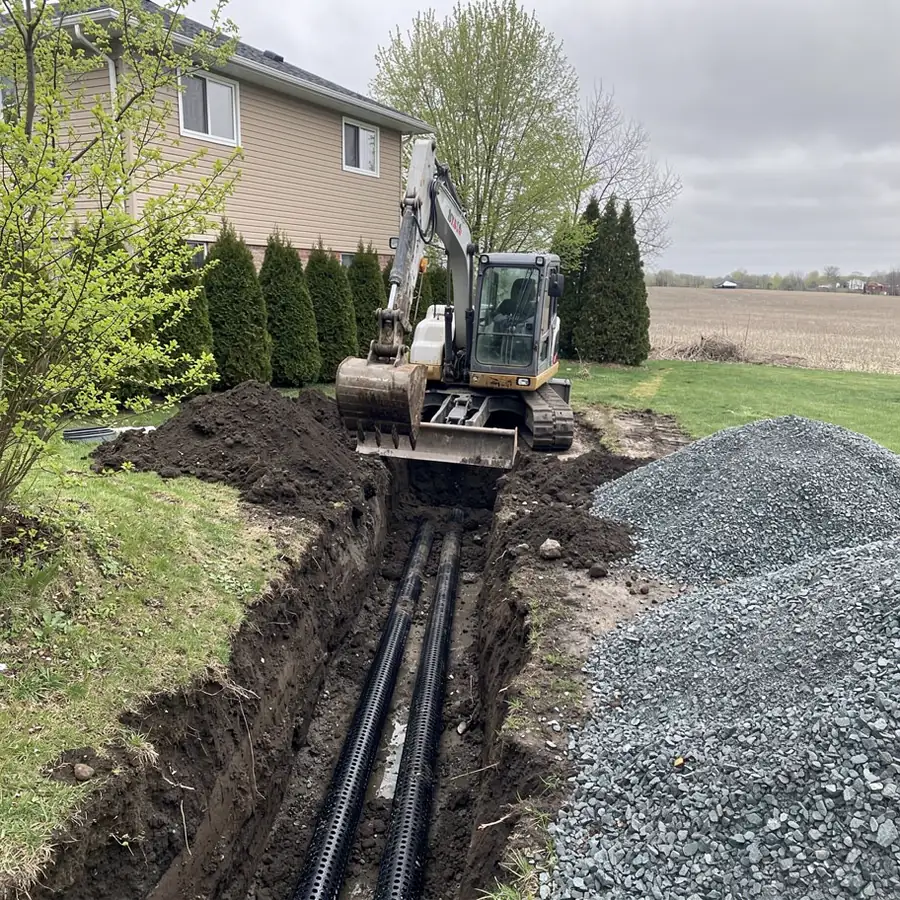
Excavator removing failed septic bed in Puslinch

Septic System Types in Ontario

The right septic system depends on how fast the soil drains, how high the water table sits and how much room the lot has. A conventional in-ground bed is cheapest when the soil allows it, while raised, filter and tertiary systems solve poor soil or tight lots at a higher cost.

Soil drainage is measured as a percolation time, or T-time: the minutes it takes water to drop 1 cm in that soil. Conventional trenches work in soil with a T-time between 1 and 50, with at least 0.9 m (3 ft) of it between the trench bottom and the high water table, bedrock or tight clay.

Common Part 8 septic systems around Guelph
SystemSuits which soil and water tableFootprintRelative cost
Conventional trench bedSandy or loamy soil with a T-time of 1 to 50 and a low water tableLargest; trench length grows with T-time and house sizeLowest
Raised bedClay, shallow bedrock or a high water table; built up on imported sandLarge, plus a sand mantle around the bedModerate to high
Filter bedLots too small for trenches; effluent filters through a bed of specified sandCompact bed, with a mantle extending downslopeModerate to high
Shallow buried trenchThin soil over rock or clay, paired with a Level IV treatment unitSmallHigh, driven by the treatment unit
Tertiary treatment unit (for example, Waterloo Biofilter)Small lots, poor soil, or sites close to wells and waterSmallest bed areaHighest; also needs an ongoing service agreement

The Waterloo Biofilter is manufactured in Rockwood, just east of Guelph, and like other tertiary units it must be serviced on a schedule under Part 8. The designer picks the system from the soil findings, and we build whichever one the permit approves.

Part 8 Permits, Designers and Licensed Installers

Every septic system in Ontario is regulated by Part 8 of the Ontario Building Code, O. Reg. 332/12, and needs a sewage system permit before construction, including most tank and bed replacements. In Wellington County the permit comes from the local municipality's building department, such as the Township of Puslinch, the Township of Guelph/Eramosa or Centre Wellington, not from the county.

Part 8 also says who can do the work. Unless they are a professional engineer, the person who designs a system must hold a Building Code Identification Number (BCIN) in the on-site sewage systems category, and a business that installs systems must be BCIN-registered with qualified staff.

Our part is the excavation and construction, built to the BCIN-qualified designer's permit drawings with the installation registered under a qualified installer. We book the building inspector at each stage the permit lists.

Puslinch publishes a plain-language sewage system permit handout showing what an application needs, and other townships ask for similar documents. To check a septic professional's registration, the Ontario Onsite Wastewater Association keeps a member directory.

Our Septic Excavation Process

A septic installation runs through five stages, and the township inspector signs off before anything is buried. A typical replacement takes 3 to 6 working days on site once the permit is issued.

  1. Site Evaluation and Test Pits

    We dig test pits where the bed will go, usually two or more at about 1.5 to 2.5 m (5 to 8 ft) deep, so the designer can log the soil layers, estimate the percolation (T-time) and find the seasonal high water table. Mottled orange and grey soil marks where water has sat, which tells the designer how high the bed must be built.

  2. Design and Permit

    The designer sizes the tank and bed to the house using the daily design flow in Part 8, then submits the design, a site plan and the fee to the township building department. Permit review in rural townships often takes 2 to 4 weeks, and longer during the spring rush.

  3. Tank Excavation and Setting

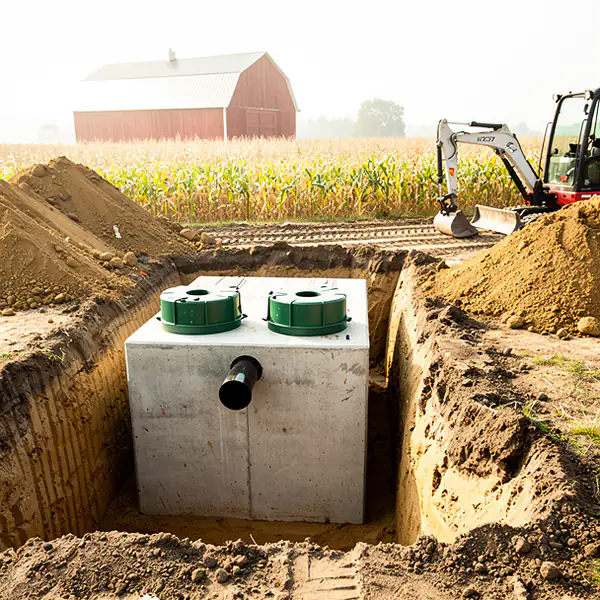
    We dig the tank hole to the depth on the drawings, compact a level granular base and set the tank with a crane truck or our excavator. Inlet and outlet connections are sealed watertight, and risers come up to grade so the lids stay reachable.

  4. Bed Construction With Imported Sand

    For raised and filter beds, we strip the topsoil, scarify the native ground and place imported sand that meets the designer's specification, compacting it in layers. Then we lay clear stone, set the perforated distribution pipe at the spacing and slope on the drawings, and cover the stone with geotextile so fill cannot wash in.

  5. Inspection, Backfill and Final Grade

    The township inspector checks the tank, the pipe layout and the bed before anything is covered. Once it passes, we backfill, cap the bed with topsoil, shape it to shed rainwater and seed it so roots hold the cover before winter.

    Around the finished system, our grading and levelling crew directs roof and yard runoff away from the bed so it only handles household water.

Required Clearances From Wells and Lot Lines

Part 8 sets minimum horizontal distances between each part of a septic system and the things it could contaminate or undermine. The leaching bed needs the larger clearances from wells and buildings because that is where effluent enters the soil.

Minimum horizontal clearances under OBC Part 8
Distance fromSeptic tankLeaching bed (distribution pipe)
Drilled well with a watertight casing at least 6 m deep15 m (50 ft)15 m (50 ft)
Dug well or any other well15 m (50 ft)30 m (100 ft)
Lake, river, pond, stream or spring15 m (50 ft)15 m (50 ft)
Property line3 m (10 ft)3 m (10 ft)
House or other structure1.5 m (5 ft)5 m (16 ft)

Your neighbour's well counts too, so we find wells on adjoining lots before the designer finalizes the layout. Conservation authorities such as the GRCA can add their own setbacks near wetlands and watercourses, which may push a bed further from a stream than Part 8 alone requires.

Septic System Cost in Ontario

A complete septic system in the Guelph area typically costs $18,000 to $30,000 with a conventional in-ground bed, $25,000 to $45,000 with a raised or filter bed, and $35,000 to $60,000 with a tertiary treatment unit. A septic tank replacement on its own usually runs $5,000 to $12,000.

Design, permit and soil-test fees usually add $2,000 to $4,000. We give a fixed written quote once we have walked the site and seen the designer's drawings.

  • Soil. Clay or a high water table means a raised bed and a lot of imported sand.
  • Raised versus in-ground. A raised bed can take 15 to 30 truckloads of sand, often the single largest material cost.
  • Access. A narrow driveway, a bed behind the house or a soft lawn adds mat work and calls for smaller machines.
  • Tank material. Concrete tanks cost less but need a crane truck; plastic tanks cost more but go in with an excavator.
  • The old system. Old tanks are pumped, then removed or crushed and filled, and failed bed material is hauled away.

Concrete septic tank set in Wellington County

Septic Excavation FAQs

How long does a septic bed last?

A well-maintained leaching bed in Ontario typically lasts 20 to 30 years, and a concrete tank often outlasts it. Beds fail early when the tank is not pumped every 3 to 5 years, when solids escape into the distribution pipe, or when the household sends more water than the system was designed for.

Driving or parking on the bed, planting trees close to it and draining a water softener or hot tub into the system also shorten its life.

My bed failed. Do I need a whole new system?

Not always. If the tank is sound and correctly sized, often only the bed needs replacing, and if the bed is healthy but the tank is cracked or rusted through, a tank swap can be enough.

A replacement still needs a permit and must meet current Part 8 rules, so an old undersized bed may come back larger. The test pits and tank inspection show which parts can stay.

Who issues septic permits near Guelph?

The local municipality's building department issues the permit. Around Guelph that means the Township of Puslinch, the Township of Guelph/Eramosa for Rockwood and Eden Mills, Centre Wellington for Fergus and Elora, and the City of Guelph for the few city properties still on septic.

For Campbellville and rural Milton, which sit in Halton Region rather than Wellington County, we confirm the permit office for each address before the designer applies.

Can a septic system go in during winter?

Sometimes, if the ground is not deeply frozen and the township can inspect on schedule. Frozen sand and soil cannot be compacted properly, and snow in an open bed adds water the system was not built for, so most installs happen from May to November.

In an emergency, such as a collapsed tank in January, we can replace the tank right away and schedule the bed work for spring.

What size septic system does my house need?

Part 8 sizes the system on a daily design flow that starts with the number of bedrooms: 1,100 L per day for 2 bedrooms, 1,600 L for 3, 2,000 L for 4 and 2,500 L for 5. The figure rises for a large floor area or a high fixture count, and the designer uses whichever calculation is highest.

The tank must hold at least twice the daily design flow, with a 3,600 L minimum, and the bed grows with both the flow and the soil's T-time.

Septic Work in Puslinch, Rural Wellington County and Campbellville

Most of our septic work is in the townships around Guelph, where homes rely on private wells and sewage systems. Each municipality runs its own permit desk, so the paperwork changes when you cross a township line.

Puslinch

Tank swaps, raised beds and pre-sale exposure digs for septic installation in Puslinch, from Aberfoyle and Morriston to the lots around Puslinch Lake.

Guelph, Rockwood and Guelph/Eramosa

Septic replacement on rural Guelph edges and in the Rockwood and Eden Mills area east of the city, a short drive from our Guelph excavation base.

Campbellville and Milton

Bed and tank replacement on escarpment and country lots for septic work in rural Milton, where shallow bedrock around Campbellville often calls for a raised bed.

Book a Septic Site Evaluation

Send us the basics and we will arrange a site visit, test pits and a designer, so you know which system your lot needs and what it will cost.

  • Property address, and the lot size if you know it
  • The home inspection or septic inspection report, if one flagged the system
  • Number of bedrooms and the approximate finished floor area
  • Where your well is, and any neighbouring wells you know of
  • Photos of the tank lids, the bed area and the route in from the driveway

Reach us at 548-918-0387 any day of the week, including Sundays from 9:00am.

Open Monday to Saturday 6:00am to 9:00pm and Sunday 9:00am to 9:00pm.

Call 548-918-0387Free Quote