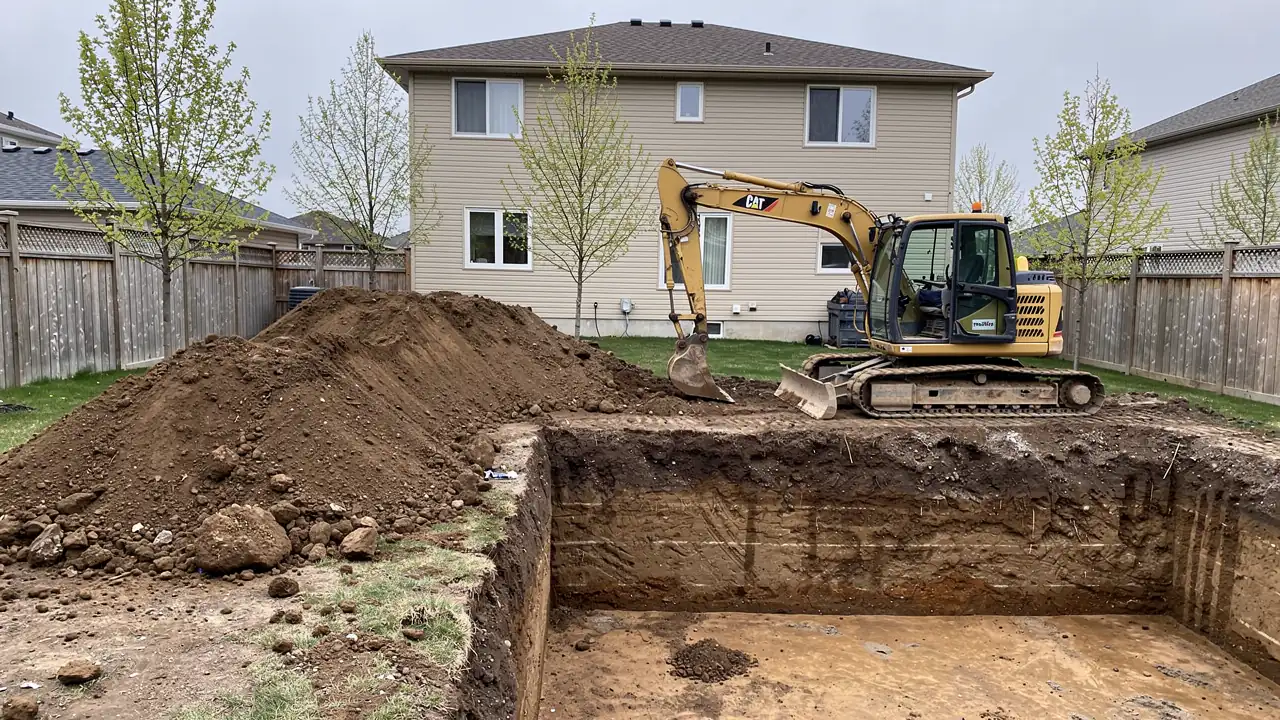
Excavator digging inground pool in Guelph backyard

Pool and Pond Excavation in Guelph

Guelph Excavation Pros digs inground pools and ponds for pool builders, homeowners running their own install and rural owners who want water on their land. After 10+ years and more than 500 jobs in Guelph's clay-loam and glacial till, we know how a pool hole behaves before the shell or liner goes in.

Every pool excavation we quote covers the layout check, the dig, the spoil and the backfill once the pool is set. Pond digging follows the same pattern, with the shape, depth and water source planned around the soil on your property.

Depth accuracy matters more than speed. A fibreglass shell set 50 mm (2 in) out of level shows at the waterline for the life of the pool, and a vinyl liner wrinkles or pulls tight when the hopper is cut wrong, so we check grades with a laser as we dig rather than after.

Pool and Pond Excavation Services in Guelph

We take on four kinds of pool and pond digging, from a tight suburban backyard to an open field. Most Guelph jobs combine two or more, such as an inground pool dig booked together with spoil removal and backfill.

Inground Pool Digs

We dig vinyl liner, fibreglass shell and concrete pools to the spec sheet your pool builder provides. That covers the over-dig around the walls, the shallow-end floor, the transition slope and the hopper for diving-depth pools.

Homeowners installing a pool kit get the same service: send the manufacturer's excavation drawing and we dig to it. On sloped lots we can also build armour stone or block retaining walls on the low side to hold the pool deck level.

Backyard Ponds and Water Features

Decorative ponds, koi ponds and stream-and-waterfall features usually need a shelved dig 0.6 to 1.2 m (2 to 4 ft) deep with planting ledges around the edge. We shape the shelves, save the topsoil for the surrounds and leave a smooth, stone-free base ready for underlay and an EPDM liner.

Farm and Stormwater Ponds

Rural owners around Guelph use ponds for irrigation, livestock water, fire protection and catching runoff from fields or long laneways. These digs range from a few hundred to several thousand cubic metres, and the excavated soil is usually built into berms or spread across the property.

Spoil Removal and Backfill

A pool dig produces far more soil than most suburban lots can absorb. We haul it in tri-axle dump trucks or spread it where your grading allows, then come back once the pool is set to backfill and compact around the walls.

When the yard needs reshaping afterward, our lot grading and levelling crew sets the final slope so deck and roof water drains away from the house.

Matching the Dig to Your Pool Type

Each pool type needs a different hole. Vinyl and fibreglass pools need a precise over-dig and a carefully prepared base, while concrete pools tolerate more variation because the shotcrete fills small irregularities.

The table shows typical requirements we see on Guelph-area installs. Your builder's spec sheet always takes priority over these figures.

Typical excavation requirements by pool type
Pool typeOver-dig neededBase materialDepth toleranceBackfill material
Vinyl liner (steel or polymer walls)About 0.3 to 0.6 m (1 to 2 ft) beyond the wall line for panels and bracingFloor dug to shape, then finished by the builder with stone dust or a cement and vermiculite mixAbout 25 mm (1 in) on the floor and hopperClear stone or approved granular against the walls, native soil above
Fibreglass shellAbout 0.3 to 0.45 m (12 to 18 in) beyond the shell on every side100 to 150 mm (4 to 6 in) of 10 mm (3/8 in) clear stone or stone dust, screeded levelAbout 13 mm (1/2 in) across the rimClear stone, raised in step with the water inside the shell
Concrete (shotcrete or gunite)About 0.3 m (1 ft) for steel and forming, plus the shell thicknessCompacted native subgrade or 100 to 150 mm of Granular AAbout 50 mm (2 in), since the shell thickness absorbs small variancesNative soil or granular after the shell has cured

Fibreglass is the least forgiving. The shell arrives as one rigid piece, so the base must be flat in every direction, and we screed and laser-check it before the shell is lowered in.

Vinyl pools on Guelph clay need the most care at the floor. Clay that dries and cracks under a liner shows through the vinyl, so we leave the final 50 mm until the builder is ready to finish the floor that same day.

Concrete pools are dug closest to the finished shape. The shell is sprayed directly against the soil or forms, so a clean, undisturbed wall matters more than a millimetre-perfect cut.

Pond Options: Lined, Clay-Sealed or Groundwater-Fed

A pond holds water in one of three ways: a synthetic liner, a compacted clay seal or a basin dug down into the water table. The right choice depends on your soil, how far the level can drop in August and what the pond is for.

Lined ponds use a 45 mil EPDM rubber liner over a protective underlay. They suit backyard ponds and water features on any soil, including sand and gravel, and hold a steady level as long as the liner stays intact.

Clay-sealed ponds rely on native clay compacted in layers across the bottom and banks. Much of the Guelph area sits on clay-rich glacial till that can seal a farm pond with no liner at all, but we dig test pits first to confirm the clay runs deep enough and has no gravel seams.

Groundwater-fed ponds are dug below the water table, so springs and seepage keep them topped up. They work on low ground and on the sandy, gravelly moraine found in parts of Puslinch, although levels can swing 0.5 to 1 m (1.5 to 3 ft) between spring and late summer.

For irrigation and livestock ponds, we aim for at least part of the basin to reach 2.5 to 3.5 m (8 to 12 ft) deep. That depth keeps the water cooler, slows weed and algae growth and holds a reserve through a dry summer.
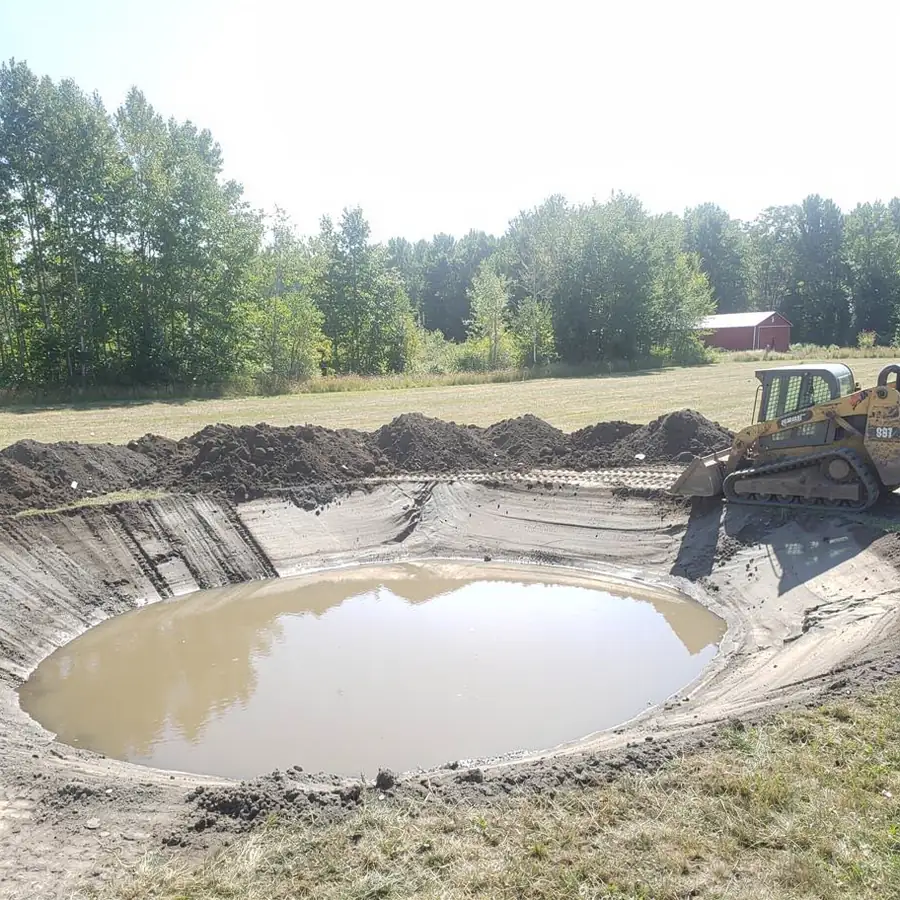
Newly dug farm pond in Puslinch field

Getting Equipment Into Your Backyard

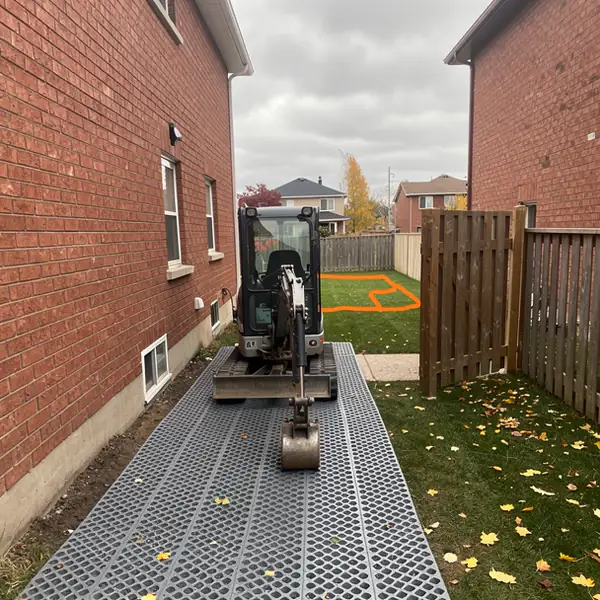
Gate width decides which machine we bring, because most Guelph pool digs go in through a side yard. Our narrowest compact excavator measures roughly 1 m (39 in) across its tracks and passes through a standard backyard gate, while a 5 to 8 tonne excavator needs roughly 2.1 m (7 ft) of clear width.

In many newer subdivisions the gap between houses is only 1.2 to 1.8 m (4 to 6 ft), and an air conditioner or gas meter narrows it further. If the larger machine will not fit, we either remove a fence panel or two and reinstall them afterward, or use the compact excavator with a mini track loader to carry spoil out.

Composite ground protection mats go down over the lawn route to spread the machine's weight and keep ruts out of the turf. Interlock, irrigation lines and shallow services along the route are marked before the first machine moves.

  • Measure the gate opening at its narrowest point, including hinges and latch posts
  • Note anything in the side yard, such as AC units, window wells, downspouts and gas meters
  • Tell us if a neighbour has agreed to let us cross their property
  • Photograph any overhead wires along the route and above the pool area
Mini excavator entering narrow Guelph backyard gate

Our Pool Excavation Process

A typical inground pool dig moves through five steps over one to two weeks of calendar time, most of it waiting on locates and the pool delivery. The digging itself usually takes one to two days.

  1. Layout With Your Pool Builder

    We meet the builder on site to paint the pool outline, set the coping elevation relative to the house and mark the depth points. We also mark the equipment pad for the pump, filter and heater so plumbing and electrical trenches can follow a clean route.

    If an old patio or walkway sits inside the footprint, our concrete breaking and removal service takes it out before the dig starts.

  2. Locates and Permits

    Free utility locates are booked through Ontario One Call, and a single-address request normally clears in 5 business days. You or your builder apply for the City of Guelph pool enclosure permit, and we start digging only once both are in hand.

  3. Digging to Laser-Checked Depth

    We dig the shallow end first, then the slope and the deep end, checking every few metres with a rotating laser and grade rod. For diving pools, the hopper is cut to the builder's profile with the last few centimetres trimmed by hand.

  4. Spoil Hauled or Spread

    A 16 x 32 ft (4.9 x 9.8 m) pool typically produces 75 to 90 m³ of loose soil, or roughly 6 to 8 tri-axle truckloads. That soil goes to a receiving site, gets spread on your property or is partly stockpiled for backfill, depending on what you choose.

    Larger volumes, such as a farm pond or a pool on a lot with no room to spread, are handled by our earthmoving and soil removal team.

  5. Backfill After the Pool Is Set

    Once the walls or shell are set and plumbed, we return on the builder's schedule to backfill. Fill is placed in layers roughly 200 to 300 mm (8 to 12 in) thick, each one compacted with a plate compactor so the deck does not settle later.

    With fibreglass, backfill rises at the same pace as the water inside the shell, keeping pressure equal on both sides of the wall.

Permits for Pools and Ponds

A backyard pool in Guelph needs a City of Guelph pool enclosure permit, and it should be issued before we dig. The enclosure must meet the City's minimum fence height, generally 1.5 m (5 ft), with self-closing and self-latching gates.

Some ponds fall under the same rules. Municipal pool by-laws commonly treat any outdoor body of water deeper than about 0.6 m (24 in) as a pool, so a deep koi pond may need an enclosure too.

Ponds near a creek, wetland or floodplain need a permit from the Grand River Conservation Authority under O. Reg. 41/24. The regulated area often extends well past the water's edge, so we check GRCA mapping before quoting any rural pond.

Rural ponds outside the city also answer to township and town rules. The Township of Puslinch building department can advise on large digs near a septic system, and in Milton the regulated areas are administered by Conservation Halton.

Pool and Pond Excavation Cost

Most inground pool excavation in Guelph costs $3,500 to $8,000 for the dig and haul-away, with backfill adding $1,500 to $3,000. Backyard ponds usually run $800 to $3,500, and farm ponds start around $6,000 and climb with size.

Every job gets a written quote after a site visit, and that price is fixed. The drivers below explain where your project lands within those ranges.

What drives pool and pond excavation cost
Cost driverHow it affects the priceTypical effect
Pool sizeMore area means more machine hours and more truckloadsA 20 x 40 ft pool produces about twice the soil of a 14 x 28 ft pool
Depth and hopperDeep ends and diving hoppers add volume and hand trimmingAdds $500 to $1,500 over a flat-bottom sport pool
Haul-awayTrucking plus tipping fees at the receiving site$180 to $300 per tri-axle load
RockLimestone ledges need a hydraulic hammer or a larger machine$200 to $300 per hammer hour
AccessNarrow gates mean a compact machine, more hours and sometimes a mini loaderAdds 30 to 60% to dig time
GroundwaterPumping, a sump at the deep end or a relief system under the floor$400 to $2,000 depending on inflow

Leaving the spoil on site is the biggest saving, often $1,500 or more on a mid-size pool. It only works when there is room to spread it without changing drainage toward your house or a neighbour's lot.

Replacing an old pool rather than adding a new one? Our swimming pool removal service breaks out the old shell and prepares the hole for the new install.

Pool and Pond Excavation FAQs

These are the questions Guelph homeowners and pool builders ask us most often before booking a dig.

How long does it take to dig a pool?

The dig itself usually takes one to two days with a standard excavator and open access. Narrow-gate jobs with a compact machine take two to four days, and backfill is a separate half day to full day after the pool is set.

How much soil comes out of a pool dig?

A 16 x 32 ft pool produces about 75 to 90 m³ of loose soil, which fills 6 to 8 tri-axle dump trucks. Soil swells by roughly 20 to 30% once it is dug, which is why the pile always looks bigger than the hole.

Can you dig a pool through a narrow gate?

Yes, the compact machine we use for tight yards squeezes through most gates of 1.1 m (42 in) or more. The smaller bucket and the need to shuttle spoil out to the street roughly double the dig time compared with a full-size machine.

Do I need a permit for a backyard pond?

It depends on depth and location. A shallow decorative pond usually needs none, but a pond deeper than about 0.6 m may trigger pool enclosure rules, and any pond inside a regulated area needs a GRCA or Conservation Halton permit.

What if you hit rock or groundwater?

We stop, show you what we found and explain the options before going further. Rock is broken out with a hydraulic hammer at an hourly rate, and groundwater is pumped to a filtered discharge point, with both priced as separate line items you approve first.

Pool Digs Across Guelph, Puslinch and Milton

We dig pools and ponds throughout the 30-minute radius around our Guelph yard. Soil, lot size and permit rules shift from one community to the next, and each shift changes how we plan the dig.

Guelph

Guelph pools are mostly suburban backyard digs through side gates, often in clay that needs careful floor prep. Read more about our excavation work in Guelph.

Puslinch

Puslinch lots are larger and usually on septic, so many jobs are rural ponds dug into sandy moraine or clay pockets. See our Puslinch excavation services.

Milton

New-subdivision backyards in Milton are compact, with engineered grading and tight side yards that call for the compact machine. Find out more about digging and excavation in Milton.

Book Your Pool or Pond Dig

Send us your pool details and we will visit, confirm access and give you a fixed written quote. Call or text 548-918-0387, Monday to Saturday 6:00am to 9:00pm and Sunday 9:00am to 9:00pm.

  • Your pool builder's spec sheet or excavation drawing, or the pond size and depth you have in mind
  • Photos of the backyard and the route from the street
  • Your gate width at the narrowest point
  • Whether you want the spoil hauled away or spread on site
  • Your target dig date and the pool delivery date

Open Monday to Saturday 6:00am to 9:00pm and Sunday 9:00am to 9:00pm.

Call 548-918-0387Free Quote