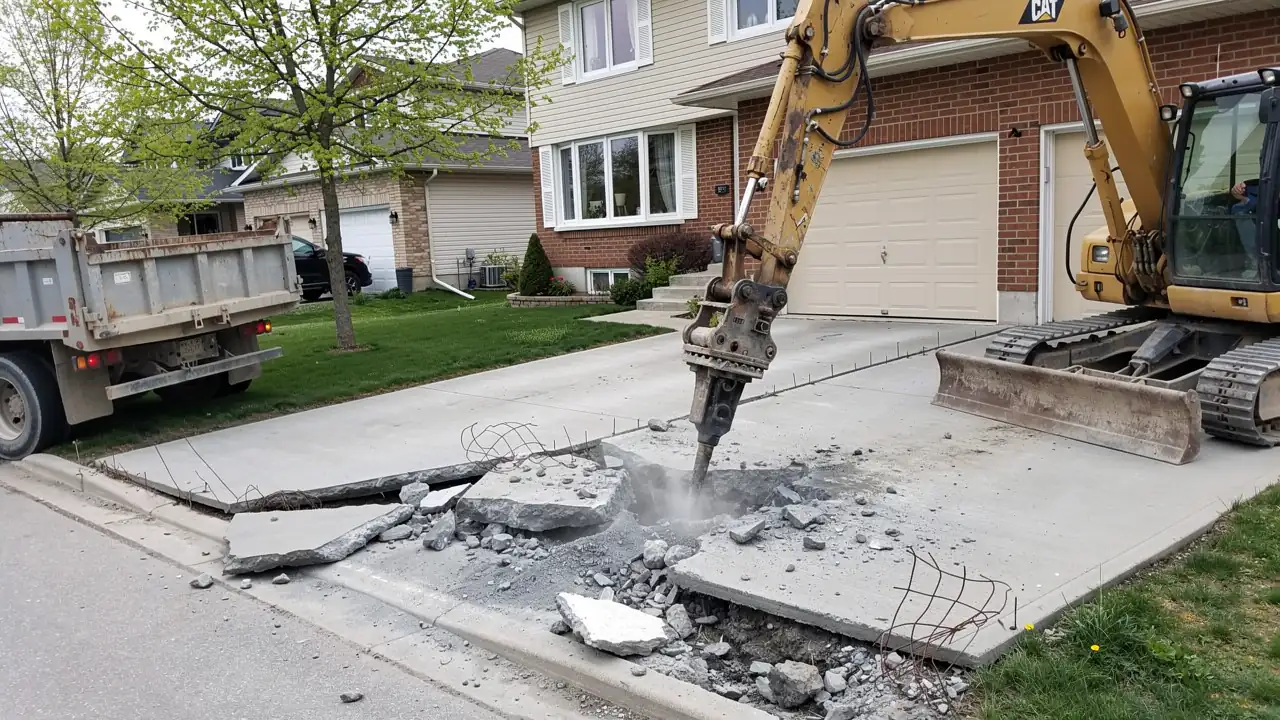


Excavator breaker removing concrete driveway in Guelph

Concrete Breaking and Removal in Guelph

Guelph Excavation Pros breaks out and hauls away concrete for homeowners, renovators and contractors across Guelph and Wellington County. We remove driveways, patios, garage floors, footings and basement slabs, then send clean concrete to be crushed and recycled. More than 10 years and 500+ jobs have taught us that the cut line matters as much as the break.

Most of our concrete demolition calls come from owners replacing a cracked driveway or a tired patio, renovators clearing a basement floor, and builders who need old footings gone before new forms go in. Every slab removal starts with a diamond saw cut at the edge of whatever stays, so the break stops exactly where it should.

Concrete breaking looks simple until a breaker cracks the neighbour's walkway or rattles a foundation wall. We size the machine to the slab, control vibration near structures, and leave a graded, swept site ready for the next trade. Quotes are free, and the written price is fixed after a site visit.

Concrete Breaking and Removal Services

We remove residential and light commercial concrete of almost any thickness, from 75 mm (3 in) walkways to 300 mm (12 in) reinforced footings. Each job type below calls for a different machine, cut plan and disposal route.

Driveway and Walkway Removal

We remove whole driveways or just the damaged part, such as a cracked apron at the street or a sunken strip by the garage. A saw cut separates the piece coming out from the piece staying, and a mini excavator with a hydraulic breaker lifts the slab in manageable chunks.

If the whole surface is being replaced, we can also dig out the old gravel and build new granular as part of our driveway excavation and base preparation service.


Patio, Slab and Garage Floor Removal

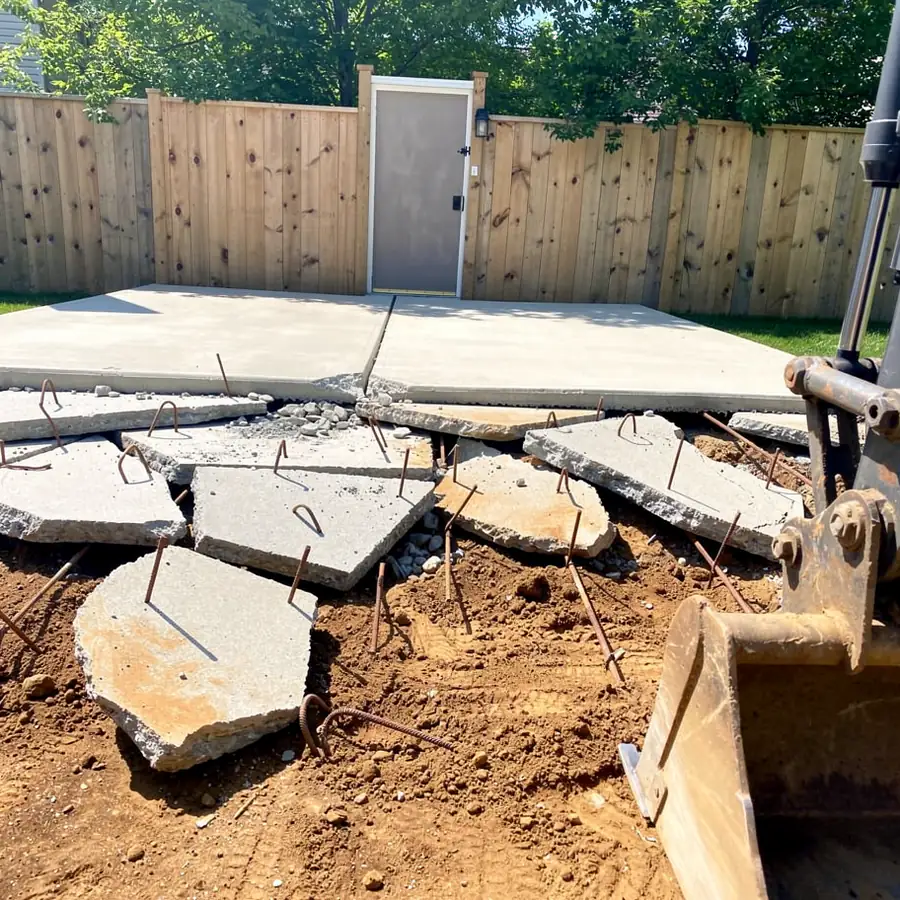
Patios and shed pads are usually 100 mm (4 in) thick with wire mesh, while garage floors and hot tub pads often run 125 to 150 mm (5 to 6 in) with rebar. Thicker reinforced slabs need a heavier breaker and more time to cut and separate the steel.

Garage floors are broken from the back wall toward the door, so debris loads straight into the truck waiting on the driveway.

Footings, Foundations and Basement Floors

Structural concrete is the heaviest work we do: strip footings, frost walls, old foundation walls and basement floor slabs. These pieces are thick, heavily reinforced and often sit next to walls that must stay standing.

Inside a house, basement floors come out with electric demolition hammers and compact machines, often ahead of a basement excavation or dig-down. Footings left behind by a removed garage or addition are broken out with an excavator once the walls are gone.

Concrete Steps, Pads and Old Walls

Poured and precast steps, air conditioner pads, low concrete walls and fence post footings are small but awkward. They tend to sit tight against siding, gas meters or foundation walls, so we often cut them free and lift them out whole instead of breaking them in place.

Bigger tear-outs that include a shed, deck or garage are handled through our demolition service, so one crew takes care of both the structure and its slab.

Breaking Methods: Hydraulic Breaker, Saw Cutting or Hand Tools

The right breaking method depends on slab thickness, how close the concrete sits to things that must stay, and how much noise and vibration the site can handle. Most jobs combine two methods: a saw to cut clean lines and a breaker to do the bulk of the work.

Concrete breaking methods compared
MethodBest forNoise and vibrationFinish edgeRelative cost
Hydraulic breaker on an excavatorDriveways, footings and slabs over about 20 m² (215 sq ft)High noise, moderate ground vibrationRough; needs a saw cut first for a clean lineLowest per square metre on large areas
Breaker on a mini excavator or skid steerBackyard patios, side yards and tight lotsModerate noise, lower vibrationRough without a saw cutLow to moderate
Diamond saw cutting (walk-behind or handheld, wet cut)Partial removals, edges against slabs that stay, new openingsLoud while cutting, almost no vibrationStraight and square, ready for new concrete, asphalt or paversPriced per linear metre and depth; added to the job
Electric demolition hammer and hand toolsBasements, garages, steps against siding and areas near fragile finishesModerate noise, very low vibrationControlled; can work right to a lineHighest per square metre, because it is slow

Wet cutting keeps respirable crystalline silica dust down, which matters indoors and next to neighbours. Silica is a designated substance under Ontario's O. Reg. 490/09, so we cut wet or use dust extraction whenever a saw or hammer is running.

What Affects a Concrete Removal Job

Four things decide how long a concrete removal takes and what it costs: thickness, reinforcement, access and what is underneath. A look at an exposed edge, a crack or a few photos usually tells us most of it.

  • Thickness: a 100 mm (4 in) patio breaks quickly, while a 200 mm (8 in) footing can take three times as long per square metre and weighs twice as much to haul.
  • Rebar or wire mesh: reinforcement holds broken pieces together, so each chunk has to be pulled apart and the steel cut before loading.
  • Access: a driveway at the street is easy; a backyard patio behind a 1.2 m (4 ft) gate needs a compact machine and many more trips to the truck.
  • The base below: if a new surface is going in, the old gravel, sand or clay may need digging out too, which turns a removal into an excavation and adds trucking.

Hidden surprises are usually one of three things: a second slab poured over an old one, a thickened edge under a driveway apron, or abandoned pipes cast into the concrete. When a slab's history is unclear, we cut a test line before quoting the full job.

Broken patio slab showing rebar in Guelph

Protecting What Stays

We protect what stays by cutting before we break, keeping heavy breaking away from foundations, and covering the lawns and finished surfaces our machines cross. Most damage on concrete jobs comes from cracks that run past the work area, and a full-depth saw cut stops them.

  • Saw-cut lines: we mark the line with you, then cut full depth with a diamond blade so the remaining slab has a straight, square edge for new concrete, asphalt or pavers to meet.
  • Vibration control near foundations: within about 1 m (3 ft) of a house, garage or retaining wall, we switch to a smaller breaker or an electric hammer and break away from the structure, never toward it.
  • Adjacent slabs and walkways: pieces are pried away from shared edges instead of hammered, so a neighbour's walkway or the city sidewalk does not crack.
  • Lawns, gardens and driveways: plywood or composite ground mats go down along machine routes, and rubber-tracked equipment is used on turf.
  • Buried services: gas lines, irrigation and low-voltage lighting cable often run right beside patios and steps, so locates are marked before the first cut.

Before we start, we photograph neighbouring slabs, foundation walls and nearby windows. That record protects you and your neighbours if a question comes up later.

Where Your Concrete Goes: Crushing and Recycling

Clean concrete from your job goes to a recycling yard, where it is crushed into recycled aggregate instead of being buried in a landfill. Rebar and wire mesh are pulled out and recycled as scrap steel.

Crushed concrete is screened into products such as recycled Granular A and clear stone, which end up under new driveways, parking lots and pipe bedding. Ontario's aggregate specification, OPSS 1010, allows recycled concrete in granular base unless a project's contract excludes it.

Recycling also keeps your price down. Tipping fees for clean concrete at a recycler are usually lower than landfill rates for mixed construction waste, so we keep concrete separate from wood, soil and garbage on every job.

Concrete with tile, asphalt, paint or oily soil stuck to it cannot always go to a recycler. We sort it on site and tell you up front if any of it has to go to landfill.

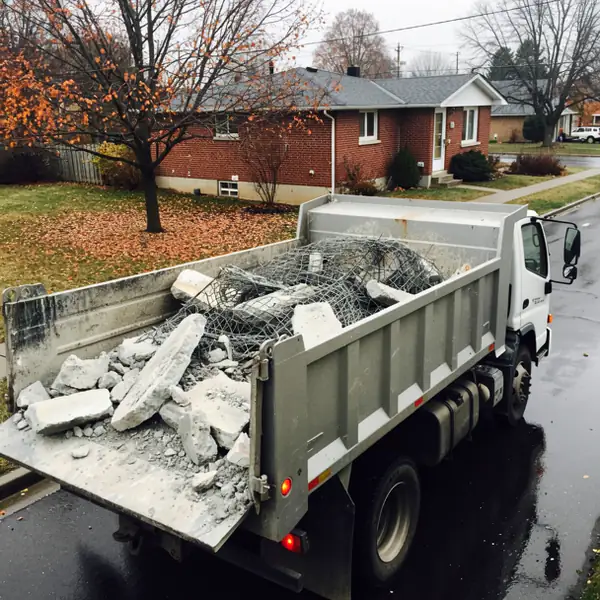
Truck loaded with concrete rubble in Guelph

Our Concrete Removal Process

A typical residential concrete removal follows four steps and finishes in a day for most driveways and patios. Footings and basement floors take longer, but the sequence is the same.

  1. Locates and Saw Cutting

    We request free utility locates through Ontario One Call before the start date, since a standard request takes 5 business days. Gas, hydro, cable and water services are marked on the ground before anything is cut.

    Next, we chalk the removal line with you and run a full-depth diamond saw cut along every edge that stays. Private lines such as irrigation, landscape lighting and buried propane are traced with you, because public locates do not cover them.

  2. Breaking and Loading

    A hydraulic breaker on the excavator fractures the slab into pieces about 300 to 600 mm (1 to 2 ft) across. The same machine pulls the pieces apart, frees the steel and loads them straight into a dump truck.

    On driveways the truck backs up to the work, so the concrete never crosses your lawn. Backyard jobs use a compact track loader or tracked dumper to shuttle loads out to the street.

  3. Base Removal or Prep

    With the concrete gone, we check what is underneath. If new concrete, asphalt or interlock is coming, we dig out soft or contaminated base and replace it with compacted Granular A to the depth that surface needs.

    If the area is going back to lawn or garden, we remove the base gravel and bring in topsoil instead, so grass is not struggling over stone.

  4. Clean-Up

    We scrape and sweep the remaining slabs, clear mud and chips off the street and driveway, and rough grade the area so water drains away from the house. Track marks across the lawn are raked out and seeded where needed.

    You are left with a site that is ready for the next trade or for planting, not a pile of rubble to deal with.

Concrete Removal Cost in Guelph

Concrete removal in Guelph typically costs $4 to $8 per square foot for a 100 mm (4 in) residential slab and $7 to $12 per square foot for thick or heavily reinforced concrete, including hauling and recycling. Most jobs carry a minimum charge of about $900 to $1,500 to cover the machine, saw and trucking.

A standard double driveway of about 55 m² (600 sq ft) usually lands between $2,500 and $4,800. Your written quote is fixed after a site visit, so the price does not change if the slab turns out tougher than it looked.

What drives the price of concrete removal
Cost driverWhy it mattersTypical effect on price
ThicknessThicker concrete takes longer to break and weighs more to haul150 mm (6 in) costs about 30 to 50% more per square foot than 100 mm (4 in)
Rebar or wire meshSteel must be cut and separated before loadingAdds roughly $1 to $3 per square foot
AreaSetup and trucking are spread over more square feetLarge jobs cost less per square foot than small ones
AccessBackyards, narrow side yards and basements need compact machines or hand toolsCan add 20 to 60% compared with open driveway access
DisposalClean concrete recycles at lower tipping fees than mixed wasteMixed or contaminated loads add landfill fees
Saw cuttingCharged by length and depth of cutAbout $15 to $35 per linear metre ($5 to $10 per linear foot)
Base removalDigging out gravel or clay adds excavation and truckingQuoted per cubic metre or as part of a new base

Bundling concrete removal with new base preparation, a swimming pool removal or a full demolition usually lowers the total, since the crew and trucks are already on site.

Concrete Removal FAQs

These are the questions Guelph homeowners and contractors ask most before booking concrete breaking. If yours is not here, send it with your photos and we will answer it in the quote.

How much does concrete removal cost in Guelph?

Most residential concrete removal in Guelph costs $4 to $12 per square foot, with a minimum charge of about $900 to $1,500. Thickness, rebar, access and whether the base comes out too are what move the price within that range.

We fix the price in writing after a free site visit.

Can you remove part of a driveway and leave the rest?

Yes. We saw-cut a straight, full-depth line where the old concrete will end, break out only the damaged section and leave the rest intact.

Partial removals are common for sunken aprons at the street, heaved sections near the garage, and strips taken out for a new walkway or a utility trench.

Do you recycle the concrete?

Yes, clean concrete goes to a recycling yard where it is crushed into aggregate for new base and fill. Rebar and mesh are separated and recycled as scrap steel.

Only concrete with contaminants, such as tile adhesive, asphalt or oil-soaked soil, may have to go to landfill, and we tell you before the job starts.

Can you break concrete inside a basement?

Yes, we break basement floors and interior footings with electric demolition hammers, compact machines and wet cutting to keep dust down. In an occupied house, the work area is sealed with poly sheeting and an air scrubber runs throughout.

Broken concrete leaves through a walkout, a window opening or a conveyor. When a floor is coming out for a dig-down, the footings must be protected first with underpinning or bench footings designed by an engineer.

How long does concrete removal take?

Most driveways and patios are removed in one day, including saw cutting and loading. A small walkway or pad takes 2 to 4 hours, and a single-car driveway about 4 to 6 hours.

Basement floors usually take 2 to 4 days, and old footings or foundation walls 1 to 3 days, depending on length and reinforcement.

Concrete Removal From Waterloo to Milton

We take on concrete breaking and removal anywhere within about a 30 minute drive of Guelph, from Waterloo in the west to Milton in the east. Each town page covers the local permits, soils and jobs we see most there.

Concrete Removal in Guelph

Driveway aprons, backyard patios and garage floors are our most common jobs in Guelph, where any work that touches a curb, boulevard or city sidewalk needs City approval first.

Concrete Removal in Kitchener

In Kitchener, we cut and lift out decades-old patios, steps and garage slabs ahead of new hardscape and renovations.

Concrete Removal in Waterloo

For Waterloo homeowners and renovation contractors, we remove slabs, steps and pads with compact machines suited to small lots and narrow side yards.

Concrete Removal in Cambridge

Our Cambridge jobs often include breaking out old concrete steps and walkways around homes in Galt, Preston and Hespeler before new landscaping goes in.

Concrete Removal in Puslinch

Rural properties in Puslinch bring larger pieces: old barn floors, shop slabs and equipment pads that call for a full-size excavator and breaker.

Concrete Removal in Milton

In Milton, we break out driveways and patios on subdivision lots and remove old foundations on rural properties toward the Niagara Escarpment.

Book Concrete Removal

Send us a few photos and the rough size of the concrete, and we will book a free site visit and send a fixed written quote. Prefer to talk it through? Call 548-918-0387, 7 days a week.

  • Photos of the concrete, including an edge or crack if you can
  • Approximate length and width, or the square footage
  • Thickness if you know it, and whether you have seen rebar or mesh
  • Where it is: driveway, backyard, garage or basement
  • Gate width and access for backyard jobs
  • What goes in next: new concrete, asphalt, pavers or lawn

Open Monday to Saturday 6:00am to 9:00pm and Sunday 9:00am to 9:00pm.

Call 548-918-0387Free Quote