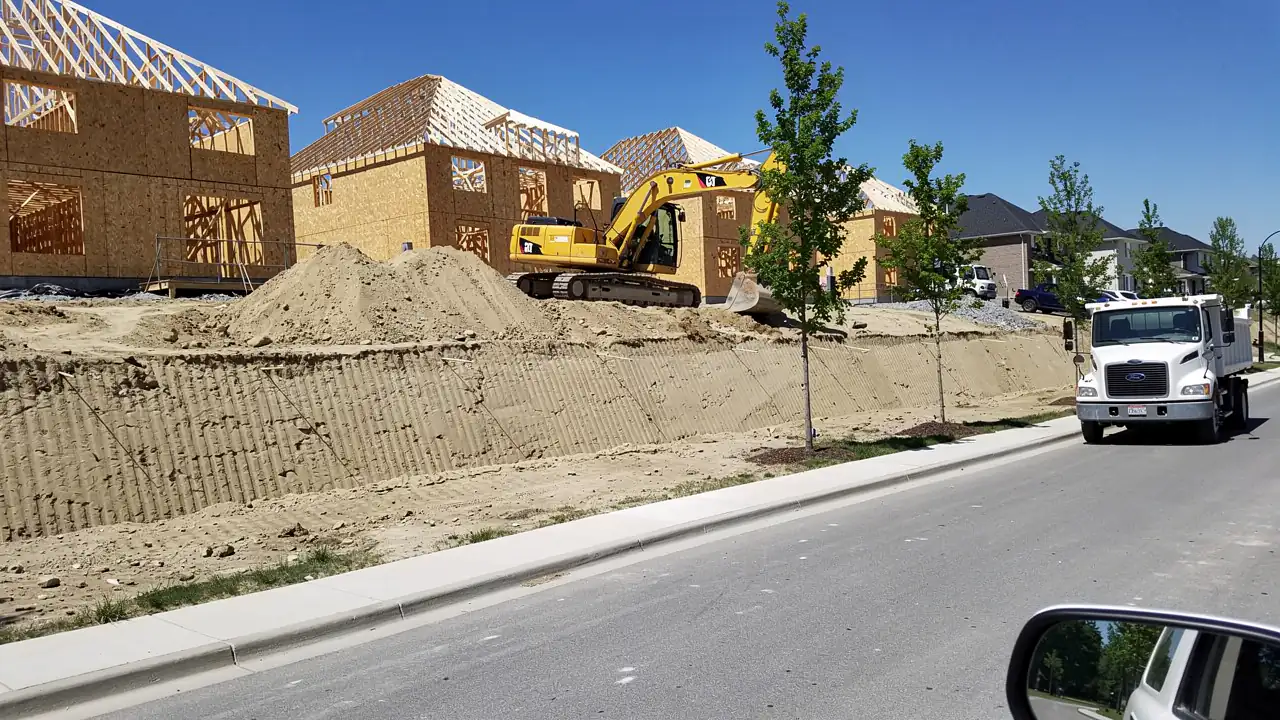
Excavator digging sandy foundation in Kitchener subdivision

Excavation in Kitchener, ON for Homeowners and Builders

Guelph Excavation Pros brings more than 10 years of excavating experience and 500+ completed jobs to Kitchener, driving in from Guelph on Highway 7. We work for homeowners adding basement units, custom builders on new lots and site contractors who need a dependable excavation contractor in Kitchener. Every crew is licensed, insured and covered by WSIB.

Most of our Kitchener work comes from three places: additional dwelling units and walkouts in mature neighbourhoods, foundations and pools in the south-end subdivisions, and servicing for infill and commercial sites. Since the City approved up to four units on many residential lots in 2024, below-grade entrances have become one of our busiest jobs here.

Kitchener ground is not Guelph ground. Large parts of the city sit on the sand and gravel of the Waterloo Moraine, which drains beautifully but caves fast, so trench support and careful sloping come first on every dig.

Excavation Services Across Kitchener

Our excavating work in Kitchener changes with the age of the neighbourhood. The older core needs tight-access digs beside old foundations, the south end needs new-build excavation, and the highway corridors need commercial site work.

Basement Units and Walkouts in Mature Neighbourhoods

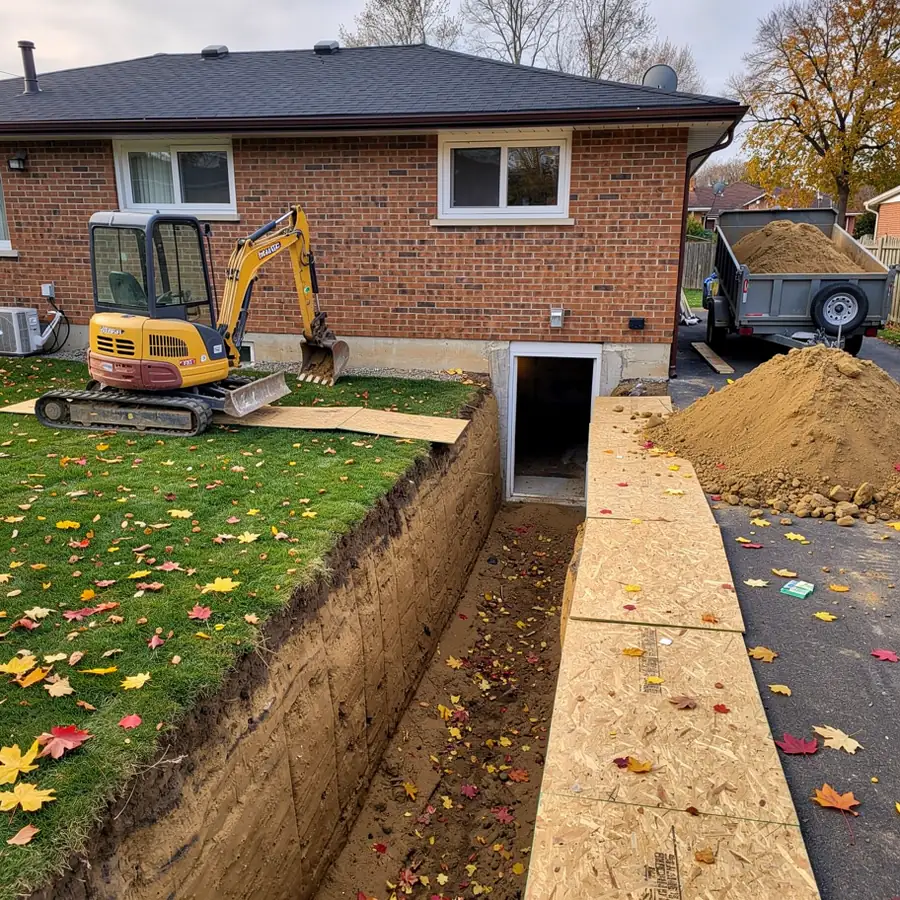
Victoria Park, Rockway, Stanley Park and Forest Heights are full of homes built between about 1900 and the 1970s that owners are now turning into duplexes and triplexes. The excavation is usually a below-grade stairwell, a full walkout or enlarged egress windows, dug 2.1 to 2.7 m (7 to 9 ft) deep beside the existing foundation.

Our basement walkout and egress window excavation service covers the dig, footing prep, weeping tile and backfill around the new opening.

New Construction in Doon South and Huron Park

Doon South and Huron Park are still adding homes, and most lots there sit on sandy moraine soil. We handle foundation excavation for new homes, pool digs and final lot grading to the approved subdivision plan.

Sand makes these digs quick, often a single day for a basement. It also means the walls must be sloped or boxed before any worker steps down beside them.

Industrial and Commercial Sites Near Highways 8 and 401

Employment lands along Highway 8 near Sportsworld and around Huron Business Park by Highway 401 bring us building pads, stormwater ponds and servicing. Our site preparation and land clearing crews strip topsoil, cut to subgrade and stockpile to the engineer's plan, with erosion control in place from day one.

Basement walkout dig at Kitchener brick bungalow

Waterloo Moraine Sand and Gravel: What It Means for Your Dig

Much of west and south Kitchener sits on the Waterloo Moraine, a thick deposit of sand and gravel with silt layers left by the last glaciers. It is the main reason trenches here need more support than in clay or till country.

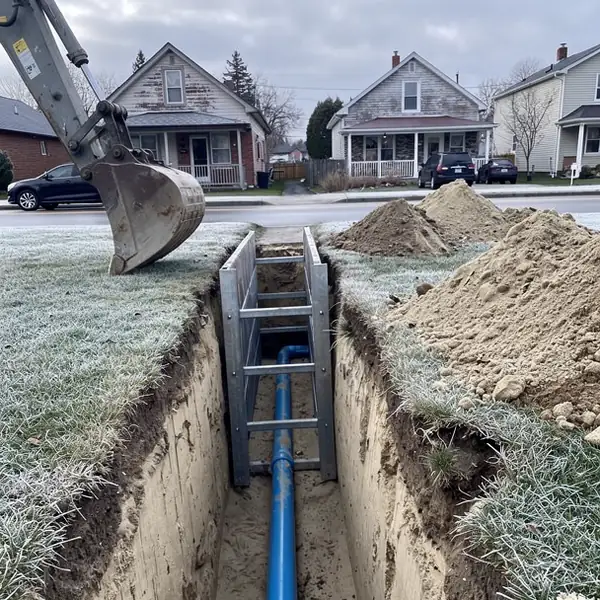
Damp sand can hold a vertical face for a while, then slump without warning as it dries or as water seeps in. Under O. Reg. 213/91, loose sand counts as Type 3 soil and saturated running sand as Type 4, so any trench deeper than 1.2 m (4 ft) must be sloped from the bottom or supported with a trench box or shoring.

Trench wall rules by soil type under O. Reg. 213/91
Soil typeTypical Kitchener exampleUnsupported wall slope required
Type 1 and 2Dense till and stiff clay in pockets away from the moraineVertical for the bottom 1.2 m, then 1 horizontal to 1 vertical above
Type 3Dry or damp moraine sand in Forest Heights, Williamsburg and Huron Park1 horizontal to 1 vertical from the trench floor
Type 4Wet, running sand below the water table or near creeks3 horizontal to 1 vertical from the trench floor, or full support

The same sand has an upside. It drains freely, so pools and foundations rarely sit in standing water, and it compacts well as backfill in 300 mm (12 in) lifts with a plate compactor.

It is also why the Region guards this ground so closely, because the moraine is the aquifer behind many of the wells that supply Kitchener's tap water. Where walls must stay vertical, such as beside a neighbour's foundation, we use shoring and underpinning excavation methods instead of sloping.

Region of Waterloo and City of Kitchener Requirements

Kitchener excavation answers to two governments: the Region of Waterloo, which runs the water supply and source protection, and the City of Kitchener, which handles building permits, lot grading and local sewers. Three requirements come up on most of our jobs.

Wellhead Protection Areas

The Region draws roughly three-quarters of its drinking water from about 100 wells, with the rest taken from the Grand River at the Mannheim treatment plant. Properties in vulnerable areas around those wells need a source protection notice with building or planning applications, and some need a risk management plan for fuel, chemical or heating oil storage.

That is why a buried heating oil tank on a Kitchener lot gets extra attention. Our oil tank and contaminated soil removal crew follows the Region's source water protection requirements when a tank comes out.

Lot Grading Approval for New Homes

Building permits for new homes in Kitchener subdivisions need an individual lot grading plan that matches the approved subdivision grading plan. After construction, the lot is certified against that plan before the grading security held by the builder or developer is released.

We dig and rough-grade to the plan elevations, keep swales where they are drawn and leave clean grades for the certifying engineer or surveyor.

Sewer and Water Service Ownership

In Kitchener, water is distributed by Kitchener Utilities, the City-owned gas and water utility, and the service is split at the shut-off near the property line. Sanitary laterals are generally split the same way, with the private side belonging to the owner and the road-allowance side to the City.

Before we excavate a failed service, we confirm who is responsible for each section so you only pay for your portion. Ontario One Call locates bring out Enova Power for hydro and Kitchener Utilities for gas and water.

Trench box in sandy Kitchener service trench

Kitchener Neighbourhoods We Serve

We dig in every Kitchener neighbourhood, from the 19th-century streets around Victoria Park to the newest phases of Huron Park. The table matches each area to its housing era and the jobs we see most.

NeighbourhoodHousing eraCommon jobs
Victoria Park1880s to 1930sBasement unit entrances, underpinning beside old foundations, sewer laterals
Forest Heights1960s to 1970sWalkouts, egress windows, pool digs in sandy soil
Laurentian Hills1970s to 1980sPools, retaining wall bases, yard regrading
Pioneer Park1970s to 1990sDrainage fixes, walkouts on ravine lots near the Grand
Doon and Doon South19th-century village core, 2000s to present subdivisionsNew-build foundations, pools, lot grading
Chicopee1980s to 2000sPools and walkouts on hilly lots, retaining walls
WilliamsburgLate 1990s to 2010sPools, basement unit entrances, driveway widening
Huron Park2000s to presentFoundations, pools, final lot grading

Two local features come up on our site visits again and again. Schneider Creek, which feeds the lake in Victoria Park, keeps groundwater high in parts of the core, while the hills around Chicopee and Pioneer Park make access planning as important as the dig itself.

Typical Kitchener Excavation Jobs

We have not published Kitchener case studies or reviews yet, so instead of polished stories, here are the three jobs we quote most in the city with typical numbers. Your site visit gives you the real figures for your lot.

Below-Grade Entrance for a Basement Unit

A stairwell entrance in Victoria Park or Stanley Park is usually 2.4 to 2.7 m (8 to 9 ft) deep and removes 25 to 45 m³ of soil. Digging and backfill take 1 to 2 days, and excavation typically runs $5,000 to $12,000 before concrete and the new door opening.

Plan the path too: under City rules, the walkway to a unit entrance that does not face the street needs a clear 1.1 m width that window wells and meters cannot block.

Pool Dig in Sandy South-End Soil

A typical vinyl or fibreglass pool in Huron Park or Williamsburg removes 60 to 110 m³ of sand and is dug in a day. Because the walls are sloped rather than vertical, we plan extra width, and excavation with haul-away usually costs $4,500 to $9,000.

Commercial Pad off Highway 8

A 0.5 to 2 ha commercial pad means stripping 200 to 300 mm (8 to 12 in) of topsoil, cut and fill to subgrade and proof-rolling before granular base. On moraine sand, compaction testing tends to pass quickly, which keeps the schedule on track.

When you compare contractors, ask each one for a recent Kitchener reference, a WSIB clearance certificate and proof of insurance. We provide all three, and our Google reviews are open for you to read before you decide.

Kitchener Excavation FAQs

Can I add a basement unit with a separate entrance in Kitchener?

In most cases, yes. Since 2024, Kitchener zoning allows up to four dwelling units on many residential lots, although lot width, servicing or natural hazards can limit some properties to one or two units.

Each unit entrance that does not face the street needs a 1.1 m wide unobstructed walkway with 2.1 m of headroom. Check your lot on the City's additional dwelling units page, and our walkout and egress window crew can dig the entrance once your permit is issued.

Why do trenches need extra support in Kitchener?

Because much of the city is built on Waterloo Moraine sand, which can collapse without warning. Ontario rules treat that sand as Type 3 or Type 4 soil, so trenches deeper than 1.2 m (4 ft) need flatter slopes or a trench box.

A cubic metre of wet sand weighs close to 2 tonnes. That is why no one on our crews enters an unsupported sand trench, however shallow it looks.

How long does it take you to reach Kitchener from Guelph?

About 25 to 30 minutes to downtown and the east side via Highway 7 and the Conestoga Parkway, and 30 to 35 minutes to Doon and Huron Park via Highway 401 and Homer Watson Boulevard. We schedule Kitchener machine deliveries early to stay ahead of traffic on Highway 7 through Breslau.

Do you handle Region of Waterloo permits?

We help with the ones tied to the excavation. That includes source protection screening near wells, work permits when a service connection crosses a Regional road, and coordination with the Region on water supply questions.

Building permits and lot grading approvals come from the City of Kitchener, and we supply the excavation details your designer or builder needs for those applications.

Book Excavation in Kitchener

Call 548-918-0387 or send the quote form to book a Kitchener site visit, any day of the week. We look at access, soil and any ADU or grading requirements, then send a written, fixed price for the excavation.

  • Your Kitchener address and neighbourhood
  • Photos of the work area and the route from the street
  • Side-yard and gate widths
  • ADU, building permit or lot grading drawings
  • Whether there is a buried oil tank or a private well on or near the lot

Open Monday to Saturday 6:00am to 9:00pm and Sunday 9:00am to 9:00pm.

Call 548-918-0387Free Quote