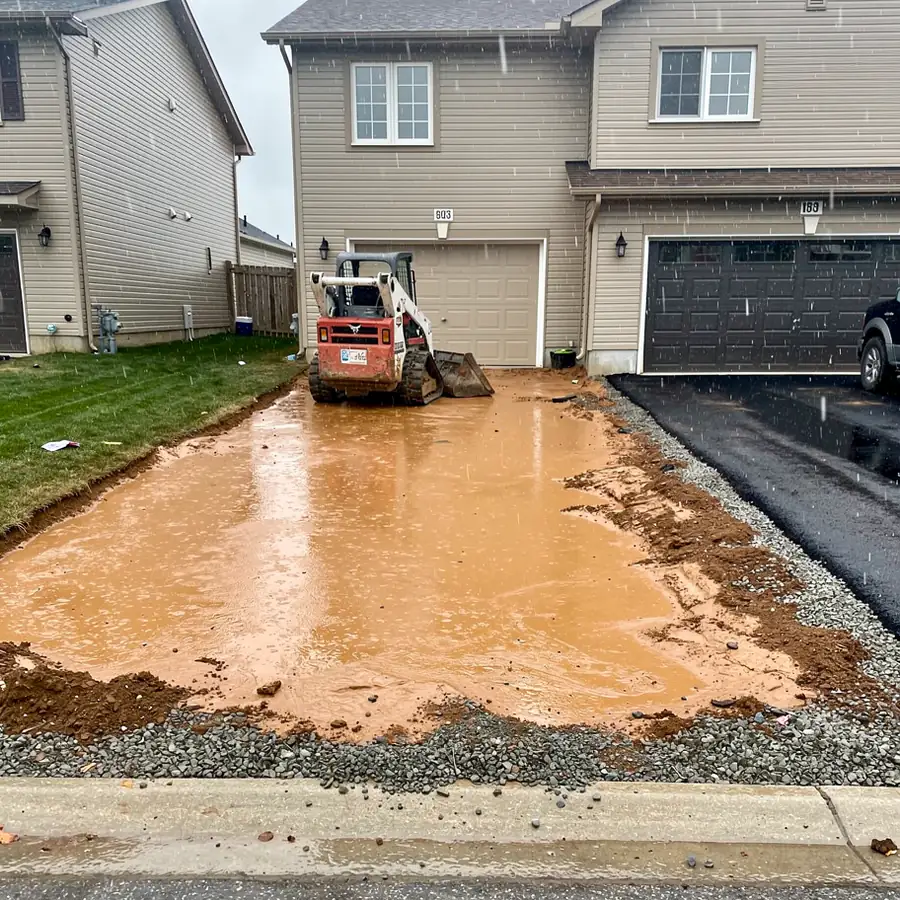
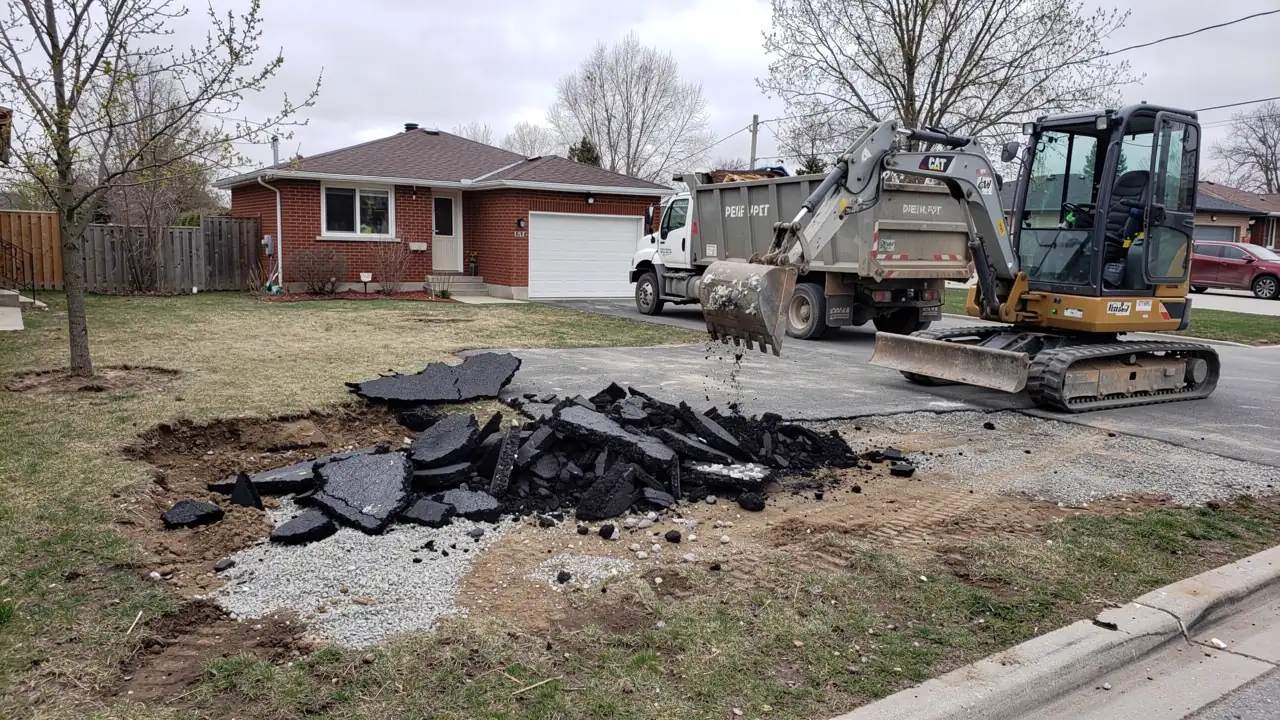
Excavator digging out old driveway in Guelph

Driveway Excavation and Base Preparation in Guelph

Guelph Excavation Pros digs out old driveways and builds the compacted granular base that new asphalt, concrete and interlock sit on. We work for Guelph homeowners replacing a tired driveway, paving and interlock contractors who want an excavation crew to handle the base, and rural owners with long gravel driveways. Across 10+ years and more than 500 jobs, we have seen that a driveway's lifespan is decided below the surface.

A driveway base is the layer of crushed gravel between the soil and the surface you drive on. Built 300 mm (12 in) deep and compacted in thin layers, it can carry an asphalt driveway for 20 years or more; laid 100 mm deep over soft clay, it starts cracking and rutting within a few winters.

Our driveway preparation covers removing the old surface, digging to the depth your new surface needs, placing and compacting Granular A, and fine grading the slope so water runs to the street. The base is ready on the day your paver or installer arrives.

Driveway Excavation Services in Guelph

Driveway preparation runs from tearing out the old surface to the last pass of the roller before paving. Hire us for the full prep, or just for the stages your paving or interlock contractor does not handle.

Old Driveway Removal

We remove asphalt, concrete and interlock pavers, along with the old edging and any failed base. Asphalt is peeled up with the excavator bucket, concrete is saw-cut and broken, and pavers are scooped out, with everything loaded into trucks at the curb.

Thick or reinforced concrete driveways go to our concrete breaking and removal crew, which cuts clean edges at the garage slab and sidewalk.

Excavation to Base Depth

Many older Guelph driveways have just 100 to 150 mm (4 to 6 in) of gravel over clay. We dig below the old base to the depth the new surface needs, typically 300 to 450 mm (12 to 18 in) under finished grade, and take out any soft or organic soil we hit.

Excavated soil is hauled away, or kept on site if you need clean fill somewhere else on the property.

Granular Base Installation and Compaction

We place Granular A, or Granular B under Granular A on deeper builds, in lifts no thicker than about 150 mm (6 in), compacting each one with a plate compactor or ride-on roller. Moisture is adjusted so the stone locks together instead of staying loose.

The finished driveway base is hard and uniform, with no movement underfoot or under a loaded truck.

Driveway Widening

Widening adds a parking space or a second lane by extending the base to the side, within the City's zoning limits. We saw-cut a clean edge on the existing driveway, dig the new strip to the same depth, and key the new base into the old so the joint does not crack.

If the wider driveway also needs a wider curb cut, City approval comes first, as explained in the rules section below.

Long Rural and Gravel Driveways

Rural driveways of 50 to 300 m are built like a small road: stripped of topsoil, crowned, ditched and often laid over geotextile. A gravel finish of Granular A or recycled asphalt keeps the cost down, with the option to pave later.

Longer lanes, shared roads and farm access are handled by our private road and laneway construction service.

Why Driveways Sink, Crack and Heave

Driveways sink, crack and heave because of what lies under them: a base that is too thin, a clay subgrade that softens when wet, water with nowhere to go, and frost lifting that wet soil in winter. Resurfacing over those problems only buys a couple of seasons.

  • Thin base: builder-grade driveways often have just 100 to 150 mm (4 to 6 in) of gravel. Tire loads pass straight through to the clay and push it down, which shows up as ruts and alligator cracking.
  • Clay subgrade: much of Guelph sits on clay-loam and glacial till that holds water. Wet clay loses strength and squeezes up into the gravel, slowly fouling the base.
  • Poor drainage: a driveway sloped toward the garage, or with downspouts emptying onto it, keeps the base saturated. Water should run off at a 1 to 2% slope toward the street or a swale.
  • Frost heave: wet soil freezes and expands from December to March, lifting slabs and pavers unevenly. When it thaws, the surface settles back in a different place, opening cracks and trip edges.

Heaving at the garage apron, sinking near the street and a dip where an old utility trench crosses are the three patterns we see most. Each points to a different fix, which is why we study the old base as it comes out.

Driveway dug out to clay in Guelph

Base Depth by Driveway Type

Most residential driveways in Guelph need an excavation 250 to 450 mm (10 to 18 in) below finished grade, depending on the surface: concrete needs the least gravel and interlock pavers the most. The table shows typical depths for cars and light trucks on average clay-loam soil.

Soft spots, heavy vehicles such as RVs or work trucks, and poorly drained lots call for extra depth or a geotextile under the base.

Typical driveway excavation depth and base by surface
SurfaceExcavation depthBase materialNotes
Asphalt300 to 400 mm (12 to 16 in)250 to 300 mm (10 to 12 in) of Granular A, or 150 mm Granular B under 150 mm Granular ATopped with 50 to 75 mm (2 to 3 in) of hot mix such as HL3; base fine graded to within about 10 mm
Concrete250 to 300 mm (10 to 12 in)150 to 200 mm (6 to 8 in) of Granular A100 to 125 mm (4 to 5 in) of 32 MPa air-entrained concrete with control joints
Interlock pavers350 to 450 mm (14 to 18 in)250 to 300 mm (10 to 12 in) of Granular A, plus a 25 mm (1 in) bedding layer80 mm vehicular pavers from makers such as Unilock or Techo-Bloc; edge restraint required
Gravel200 to 300 mm (8 to 12 in)150 to 200 mm Granular B under 75 to 100 mm Granular ALowest cost; needs topping up and regrading every few years
Recycled asphalt200 to 300 mm (8 to 12 in)150 to 250 mm of crushed recycled asphalt, alone or over Granular BBinds hard in warm weather; good for rural and gravel driveways, not under paver bedding

Granular A and B gradations are set by OPSS 1010, and you can compare them in this OPSS aggregates guide. When your paver or interlock installer specifies a different depth, we build to their spec.

Our Driveway Prep Process

Prep for a standard double driveway usually takes 1 to 2 days, from the first cut to a base ready for paving. Here is what happens at each stage.

  1. Locates and Layout

    We book free locates through Ontario One Call, since gas and water services often run right under driveways. Then we paint the final edges, check them against your property survey, and note the curb, sidewalk and garage elevations the new surface must meet.

    Tell us about anything you have added yourself, such as a lamp post cable or an invisible dog fence, because the locate service only marks utility-owned lines.

  2. Removal and Excavation

    The old surface comes out first, then the excavator digs to subgrade, taking out soft clay, topsoil or contaminated gravel. We shape the subgrade to the same slope as the finished driveway, so any water that gets in drains out instead of pooling.

    Trucks load at the street, and we keep the sidewalk and road clean as we go.

  3. Geotextile Where Needed

    If the subgrade is clay that smears under a boot, or still wet after rain, we lay a non-woven geotextile before any gravel goes down. The fabric stops clay from working up into the base and spreads wheel loads over soft spots.

    On firm, dry subgrade it is not needed, and we tell you so rather than adding cost.

  4. Granular Placement and Compaction

    Granular A is spread in layers of about 100 to 150 mm (4 to 6 in), dampened if dry, and compacted with a vibratory plate or small roller until it stops moving. Edges along the garage and walkways get extra passes with the plate, where a roller cannot reach.

    We check the base with a level and string line at each stage, and arrange compaction testing on request.

  5. Fine Grade for the Paver

    The top layer is fine graded to the exact slope and height the surface needs: about 1 to 2% fall toward the street, flush with the garage slab once surfaced, and matched to the sidewalk. One last roll leaves it tight and ready.

    For interlock, we stop at the top of the compacted base, and the installer screeds the bedding layer.

Widening and Curb Cut Rules in Guelph

You can usually widen a driveway in Guelph, but the City of Guelph Zoning By-law limits how wide a residential driveway can be and how much of the front yard must stay landscaped, and any change at the curb needs City approval first. Limits vary by zone and lot frontage, so we check your property before quoting.

  • Zoning width limits: the zoning by-law sets a maximum residential driveway width, generally tied to lot frontage, and requires part of the front yard to remain soft landscaping. Going past the limit needs a minor variance from the Committee of Adjustment.
  • Curb cuts and boulevards: widening at the street, or adding a second entrance, needs City approval before the curb, sidewalk or boulevard is touched. The curb depression itself is normally done by the City or its approved contractor at the owner's cost.
  • Trees and utilities: city boulevard trees, hydro poles, fire hydrants and water shut-off valves can limit where the driveway goes.
  • Rural entrances: on township and county roads outside the city, such as in Puslinch or Guelph/Eramosa, a new or wider entrance needs an entrance permit and often a culvert of a set size.

We help you gather the measurements and photos the City asks for, and we never cut a curb or boulevard without approval in hand. Widening within your own lot and inside the zoning limit usually needs no permit.

Driveway Excavation Cost

Driveway excavation and base preparation in Guelph typically costs $5 to $9 per square foot, or about $3,000 to $5,500 for a standard double driveway of 55 m² (600 sq ft), including removal of the old surface, excavation, Granular A and compaction. Paving, concrete or pavers are extra and priced by the surface contractor.

Your quote is fixed in writing after a site visit.

What drives driveway excavation cost
Cost driverWhy it mattersTypical effect
AreaMachine and truck time is spread over more square feetLarger driveways cost less per square foot; small jobs carry a minimum charge of about $1,500
Excavation depthMore depth means more soil out and more gravel inEach extra 100 mm (4 in) adds roughly $0.75 to $1.50 per square foot
Old surface removalAsphalt comes out fastest; reinforced concrete is slowestConcrete removal can add $2 to $5 per square foot
Base materialGranular A, Granular B and recycled asphalt are priced differentlyRecycled asphalt or a Granular B subbase can save 10 to 25% on material
AccessNarrow lots, steep slopes, long haul distances and hand work near the houseAdds machine time and truck trips
ExtrasGeotextile, drainage pipe, curb-cut coordination, rural culvertsQuoted as separate line items

Working With Your Paver or Interlock Installer

We schedule the base to finish the day before, or the morning of, your paver's or installer's start, so compacted gravel is not left exposed to rain and traffic. One call to us coordinates both crews.

Before we dig, we confirm the paver's required depth, base material, slope and edge details, such as a concrete curb or a soldier course for interlock. If your contractor's spec differs from ours, theirs wins, since they stand behind the finished surface.

Paving and interlock contractors also hire us directly as their excavation subcontractor. We take the dig, trucking and base off their plate, and they arrive to a base built to their numbers.

If weather delays the paver, we come back to regrade and recompact any area softened by rain or traffic before they start. Yards that also need water directed away from the new driveway can be regraded the same week by our grading and levelling crew.
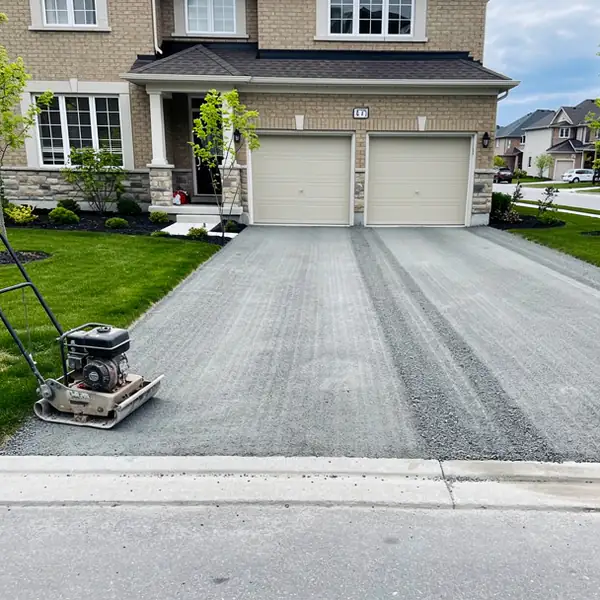
Compacted driveway base ready for asphalt paving

Driveway Excavation FAQs

Homeowners and paving contractors ask us these questions most often when planning a new driveway. Answers assume a typical Guelph lot with clay-loam soil.

How deep should a driveway be dug out?

Most driveways in Guelph should be dug out 300 to 400 mm (12 to 16 in) for asphalt, 250 to 300 mm (10 to 12 in) for concrete and 350 to 450 mm (14 to 18 in) for interlock pavers. That leaves room for the full granular base plus the surface itself.

Clay soil, poor drainage or heavy vehicles call for the deeper end of each range.

Can I widen my driveway in Guelph?

Usually yes, as long as the wider driveway stays within the City of Guelph zoning limit for your lot and you get City approval before any curb or boulevard change. Going past the limit means applying for a minor variance.

We check the limit for your zone and lot frontage at the site visit.

Is recycled asphalt good for a driveway base?

Recycled asphalt makes a good, low-cost base or surface for gravel and rural driveways, because the old asphalt binder helps it compact hard and resist washouts. It is a poorer choice under interlock, where clean crushed stone drains and beds better, and its quality varies by supplier.

We use screened recycled asphalt from consistent sources, and Granular A wherever the surface contractor specifies it.

How long after base prep can the driveway be paved?

Asphalt or pavers can usually go down the same day or the next day once the base is compacted and fine graded. Gravel needs no curing time; the only risk is rain or traffic disturbing it, so we schedule the base close to the paving date.

Concrete crews set their forms on the finished base first, usually the day after we finish.

Do you take away the old asphalt?

Yes, old asphalt goes to an asphalt recycler, where it is crushed and reused in new hot mix or as recycled base. Old concrete and clean pavers are recycled too, and excavated soil goes to approved receiving sites.

Disposal and trucking are included in the quote.

Driveway Prep From Guelph to Milton

We prepare driveway bases throughout Guelph, east through Puslinch to Milton, and west into Cambridge, all within about a 30 minute drive of our yard. Each area page covers local soil and permit details.

Driveway Excavation in Guelph

In Guelph, we rebuild driveways on older lots with thin bases over clay, and prepare widened driveways that stay within City zoning limits.

Driveway Excavation in Puslinch

Rural lots in Puslinch often need long gravel driveways and township entrance permits, which we build with culverts and a crowned granular base.

Driveway Excavation in Milton

On newer Milton subdivision lots, we replace builder-grade driveway bases ahead of interlock or asphalt and work to Town of Milton requirements at the curb.

Driveway Excavation in Cambridge

In Cambridge, we dig out sunken and cracked driveways and lay new compacted base for homeowners and the paving contractors they hire.

Get a Driveway Excavation Quote

Send us your driveway size, current surface and a few photos, and we will book a free site visit and a fixed written quote for removal and base prep. If you already have a paver or installer lined up, include their spec and start date.

  • Driveway size: length and width, or square footage
  • Current surface: asphalt, concrete, interlock or gravel
  • Photos of the whole driveway and any sunken or cracked spots
  • The new surface planned, and your installer's base spec if you have one
  • Whether you plan to widen it
  • Your target paving date

Open Monday to Saturday 6:00am to 9:00pm and Sunday 9:00am to 9:00pm.

Call 548-918-0387Free Quote