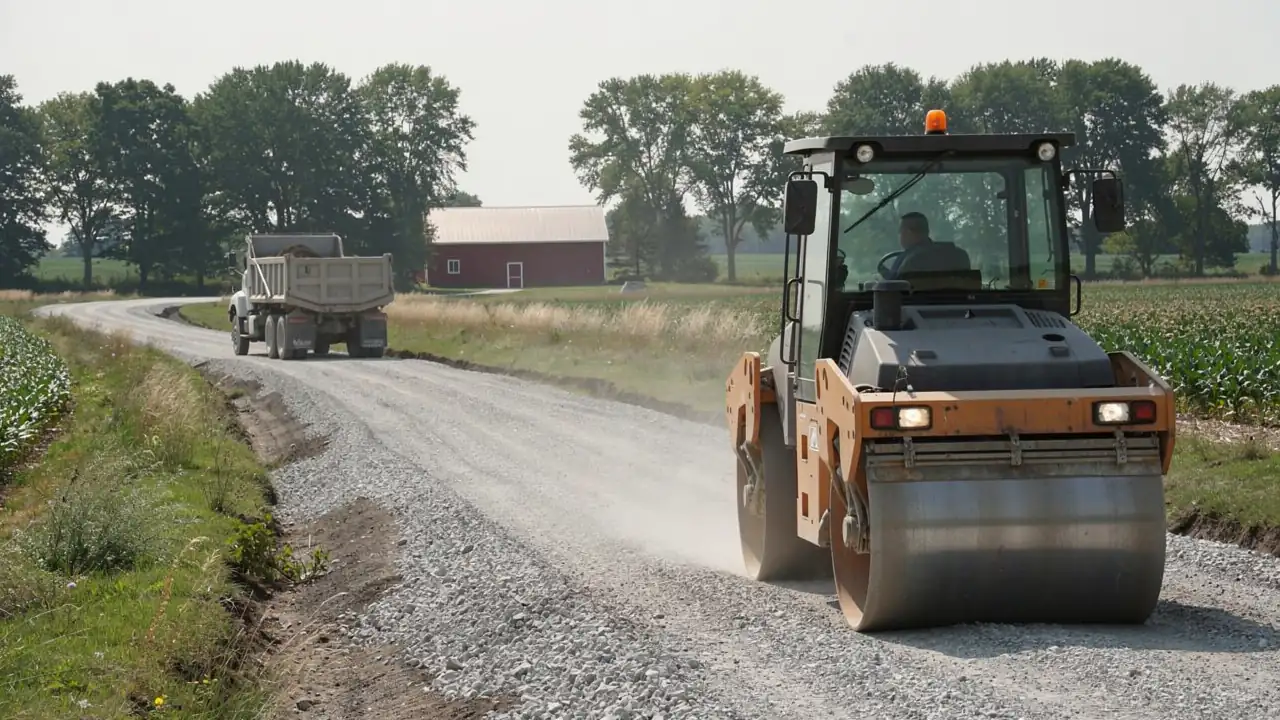
Roller compacting new private road near Guelph

Road Construction in Guelph: Private Roads, Lanes and Site Access

Guelph Excavation Pros builds private roads, long rural laneways and site access roads across Guelph and Wellington County. We work for rural landowners, farms, developers and commercial property owners, and as an earthworks subcontractor to general contractors and municipalities. Our road building crews bring 10+ years and 500+ completed jobs to each project, fully licensed, insured and covered by WSIB.

We build the parts of a road nobody sees: stripped and proof-rolled subgrade, geotextile, Granular B subbase, Granular A base, ditches and culverts. The finished structure is then fine graded for gravel, surface treatment or a paving partner's asphalt.

The surface is only the top 50 mm or so of a road; the base is what carries the trucks. Gravel and access roads that rut every spring almost always have water trapped in a thin or dirty base, which fresh stone or asphalt on top cannot fix.

Road Construction Services

Our road construction work covers new roads, temporary construction roads, the drainage that keeps them dry, and rebuilds of roads that have failed. Engineered jobs are built to the drawings and the Ontario Provincial Standard Specifications (OPSS); on private land, we design the structure with you and put it in writing.

Private and Rural Roads

Long farm lanes, shared private roads and rural access roads have to carry fuel trucks, delivery vans, fire trucks and farm equipment in every season. We build them 4 to 6 m (13 to 20 ft) wide with a crowned granular structure and ditches on both sides where the land allows.

Shorter residential driveways are covered by our driveway excavation and base preparation service.

Subdivision and Site Access Roads

On new subdivisions and commercial sites, we build roads to the municipality's standard drawings and the engineer's design, ready for assumption once the maintenance period ends. That includes subgrade and granular base for curb and gutter over freshly installed servicing.

We coordinate with the sewer, water and storm line crews so trench backfill under the road is compacted to the same standard as the road base.

Construction Entrances and Haul Roads

A temporary construction entrance, often called a mud mat, is a thick pad of 50 mm (2 in) clear stone or larger rock over geotextile that knocks mud off tires before trucks reach a public road. Haul roads inside a site give dump trucks and concrete trucks a firm route in wet weather.

Municipalities and conservation authorities usually expect a mud mat as part of a site's erosion and sediment control plan.

Culverts and Ditching

Culverts carry ditch water and small streams under the road, and ditches carry water away from the base. We install HDPE or corrugated steel culverts with proper bedding, cover and end protection, sized to the flow and the permit.

A culvert that is too short, too shallow or set at the wrong grade is the most common cause of washouts on private roads.

Road Base Repair and Rebuilds

Potholes and soft spots that return every spring are base failures, not surface failures. We dig out the failed section, find the cause, usually water or a weak subgrade, and rebuild it with drainage, geotextile and new granulars.

Patching the top only moves the problem a few metres down the road.

What Makes a Road Last Through Ontario Freeze-Thaw

A road survives Ontario freeze-thaw when its base stays drained, its granular layers are thick enough, its subgrade is firm and its crown sheds water. When any one of those is missing, spring thaw finds it.

Around Guelph, frost typically reaches about 1.2 m (4 ft) deep in a normal winter. Water in the base and in silty clay subgrade freezes into ice lenses that lift the road, then thaws from the top down in March and April, leaving saturated soil with nowhere to drain.

That is when trucks punch through: the base is wet, the still-frozen layer below holds the water in, and the road loses much of its bearing strength until it dries. Municipalities post reduced load limits on rural roads each spring for the same reason.

  • Water in the base: dirty granulars with too many fines hold water, and ditches shallower than the base cannot drain it.
  • Weak subgrade: wet clay and silt pump up into the gravel under traffic unless a geotextile keeps them apart.
  • Thin granular layers: 150 mm (6 in) of gravel over clay may survive cars, but not a loaded tri-axle in April.
  • Poor crown: a flat road ponds water, while a 2 to 4% cross slope sends it to the ditch.

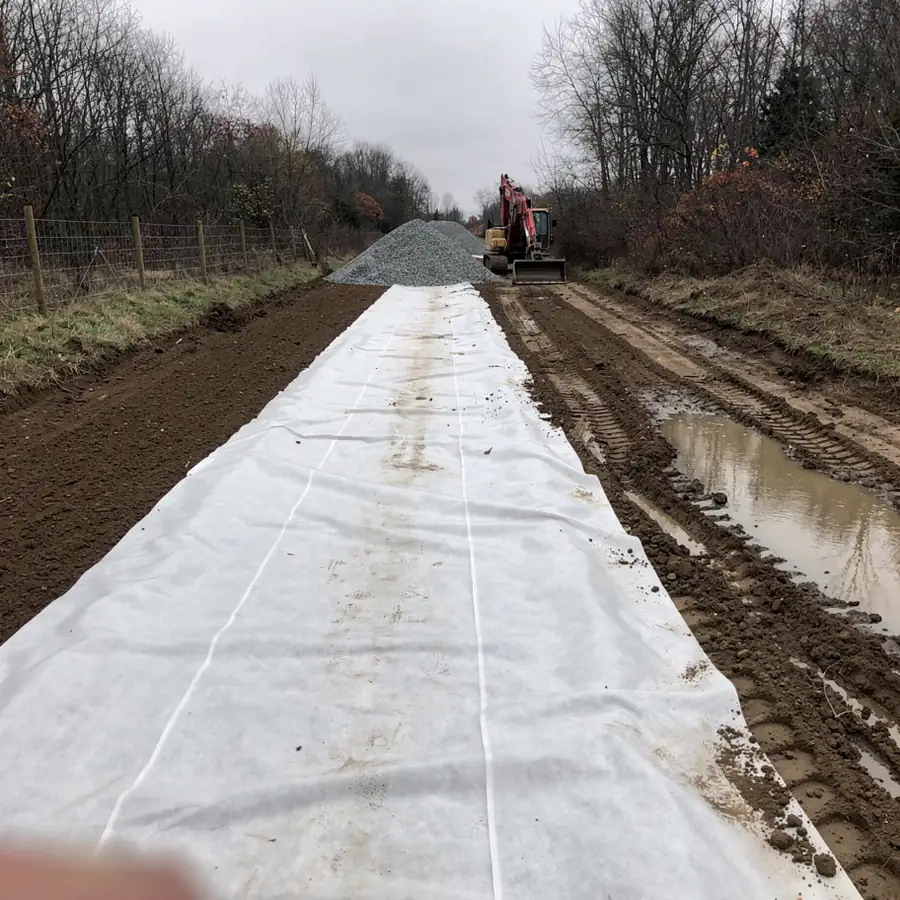
Geotextile fabric on clay subgrade for road

Road Structure and Materials

A private road in our area is usually built as compacted subgrade, geotextile, 300 to 450 mm (12 to 18 in) of Granular B, 150 mm (6 in) of Granular A and a surface. Heavier traffic or softer ground calls for more depth than the typical figures below.

Granular A and Granular B are defined in OPSS 1010, Ontario's aggregate specification, and this OPSS aggregate gradation reference lists the particle sizes for each.

Typical private road structure
LayerPurposeTypical thickness
Subgrade (native soil)Supports everything above; stripped of topsoil, proof rolled and compactedShaped to design grade with the crown built in
Geotextile (non-woven, such as OPSS 1860 Class II)Separates clay and silt from the gravel and adds stability over soft groundOne layer, seams overlapped 300 to 500 mm
Granular B Type I (pit-run sand and gravel)Subbase that spreads load and lets water drain300 to 450 mm (12 to 18 in)
Granular B Type II (crushed rock)Stronger subbase for wet ground or heavy loads300 to 450 mm (12 to 18 in), used in place of Type I
Granular A (crushed, 19 mm minus)Base course: a tight, stable layer under the surface150 mm (6 in), up to 200 mm (8 in) for heavy trucks
SurfaceWearing course that sheds water and takes trafficGravel 50 to 75 mm, two-layer surface treatment, or 50 to 90 mm asphalt

Gravel surface: Granular A or a crusher-run topping is the lowest cost and easiest to repair. It needs grading and fresh stone every few years and throws dust in dry summers.

Surface treatment (tar and chip): liquid asphalt is sprayed and covered with stone chips, usually in two layers. It costs far less than asphalt, seals the base from water and suits long rural lanes, with resurfacing roughly every 7 to 10 years.

Asphalt (HL3 surface over HL8 binder): the smoothest and longest lasting option, often 15 to 25 years with good drainage, and the most expensive up front. It needs a Granular A base fine graded to tight tolerances.

Our Road Building Process

Building a private road runs in six stages, from design review to a fine-graded base ready for its surface. On engineered projects, each stage is inspected before the next begins.

  1. Survey and Design Review

    We start with alignment, profile and drainage: where the road goes, how steep it gets, where water will run and where culverts belong. On engineered work, we review the drawings and specifications, flag conflicts and confirm the testing frequency.

    For private roads without an engineer, we walk the route with you, stake it out and agree on width, structure and surface in writing. Utility locates are requested through Ontario One Call before any digging.

  2. Strip and Excavate to Subgrade

    Topsoil and organics are stripped across the full road width and shoulders and stockpiled for the ditch slopes. We then cut or fill to subgrade elevation and build the crown into the subgrade, so water drains even below the gravel.

    Topsoil must never stay under a road, because it compresses and rots. Where the route runs through bush, our land clearing and site preparation crew clears it first.

  3. Proof Roll and Geotextile

    A loaded tri-axle dump truck or heavy roller drives the full subgrade to expose soft spots, which show up as rutting or pumping. Those areas are dug out and replaced with granular, or stabilised, before we move on.

    Non-woven geotextile is then rolled out over clay and silt subgrades with overlapped seams, keeping native soil and new granular apart.

  4. Place and Compact Granulars

    Granular B goes down first in lifts of about 150 to 200 mm (6 to 8 in), each compacted with a vibratory smooth drum roller before the next. Granular A follows in one or two lifts, watered as needed to reach optimum moisture.

    Thin lifts are what bring a road base up to specified density. A single thick lift looks fine on top and stays soft underneath.

  5. Ditches, Culverts and Shoulders

    Ditches are cut below the bottom of the granular layers so the base can drain into them, with side slopes gentle enough to mow and stabilise. Culverts are bedded, set to grade and covered to the depth the pipe needs, with rip-rap at the ends where flow is strong.

    Shoulders are built of Granular A, and topsoiled slopes are seeded or covered with erosion control blanket.

  6. Ready for Paving

    We fine grade the Granular A to the final crown and profile, check elevations and roll it tight. The base is then handed to the paver, sealed with surface treatment or finished in gravel.

    It is the same base standard we use in our parking lot construction work. On engineered roads, the handoff happens once the inspector signs off on density and grade.

Entrance Permits and Road Authority Approvals

You need an entrance permit from the road authority before connecting a new or relocated private road to a public road, and a conservation authority permit before placing a culvert in a watercourse or regulated area. Who issues each permit depends on which road the entrance joins and which watershed you are in.

  • Wellington County roads: entrances onto county roads need a permit from the County of Wellington roads department, which sets sight-line, width and culvert requirements.
  • Township roads: Puslinch, Guelph/Eramosa and the other Wellington townships issue entrance permits for their own roads, often with a minimum culvert diameter and length.
  • Regional roads: the Region of Waterloo controls regional roads in Cambridge, Kitchener and Waterloo, and the Region of Halton controls regional roads in Milton.
  • City and town streets: the City of Guelph and the Town of Milton approve new entrances onto their local streets.
  • Provincial highways: an entrance onto a highway such as Highway 6 or 7 needs a Ministry of Transportation (MTO) permit, which can take months.
  • Watercourses and wetlands: culverts in regulated areas need a permit under O. Reg. 41/24 from the Grand River Conservation Authority, or from Conservation Halton around Milton.

We help prepare the entrance sketch, sight-line measurements, culvert details and photos these applications ask for, then build to the permit's conditions. Most township permits take a few weeks, while regional roads and the MTO take longer, so apply early.

Compaction Testing and Grade Checks

On engineered roads, every granular lift is density tested by an independent geotechnical firm, often to 98% Standard Proctor maximum dry density, and grades are checked against the design before the next layer goes on. The specification on your drawings governs, and 98% is common, not universal.

  • Proctor targets: subgrade is often specified at 95% Standard Proctor and granular layers at 98%, with the lab setting the target from a sample of the actual material.
  • Nuclear density testing: a nuclear densometer reads the density and moisture of each lift in place within minutes, at a frequency the engineer sets. A failed test means more rolling, moisture adjustment or rework.
  • Grade checks: elevations are checked with a laser level or GPS rover against the design, so the crown and profile are right before surfacing.
  • Records: test reports and grade sheets go to the owner and the engineer, which is what a municipality wants to see before it assumes a road.

On private roads, testing is optional but worth it for long lanes or heavy farm traffic. We can arrange it for a per-visit fee, and it gives you written proof of what sits under the surface.

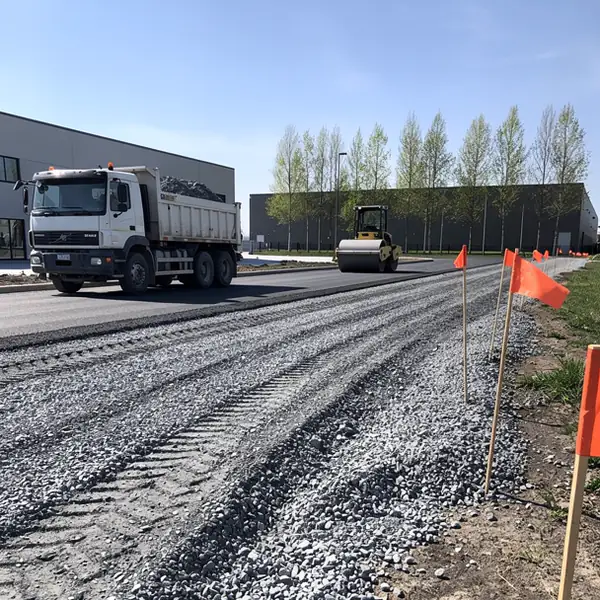
Dump truck proof rolling granular road base

Road Construction Pricing

Road construction is priced either by unit rates, per tonne of granular and per square or cubic metre of excavation, or as a lump sum for a defined scope. As a guide, a new 4 to 5 m wide gravel private road on reasonable ground typically runs $200 to $450 per linear metre before culverts, surface treatment or paving.

Engineered and municipal work is priced against the tender quantities. Private roads get a lump-sum price, fixed in writing after a site visit.

Road construction cost drivers
Cost driverTypical unitWhat moves it
Stripping and excavationPer cubic metreTopsoil depth, balance of cut and fill, haul distance for surplus soil
Granular BPer tonne placed and compactedThickness, Type I or Type II, distance from the pit
Granular APer tonne placed and compactedThickness and fine grading tolerance
GeotextilePer square metreNeeded over clay and silt; heavier fabric for very soft ground
CulvertsPer metre of pipe, plus end protectionDiameter, material, and the length set by the entrance permit
Soft spot repairPer cubic metre dug out and replacedHow much subgrade fails the proof roll
Testing and surveyPer visit or lump sumSpecified frequency and road length
SurfacePer square metreGravel, surface treatment or asphalt

For reference, Granular A placed and compacted in the Guelph area commonly prices at $35 to $55 per tonne and Granular B at $28 to $45 per tonne, mostly depending on trucking distance from the pit.

Road Construction FAQs

Landowners, farm operators and site managers tend to ask the same five things before a road project. Here are straight answers based on the ground conditions we work in.

How thick should the gravel base be for a private road?

For a private road carrying cars and light trucks, plan on about 300 mm (12 in) of Granular B under 150 mm (6 in) of Granular A. Roads used by fuel trucks, farm equipment, fire trucks or construction traffic usually need 450 to 600 mm (18 to 24 in) in total, especially over clay.

Soft or wet ground may need geotextile and extra subbase on top of that.

Do I need a permit for a new entrance onto a county road?

Yes. A new or widened entrance onto a Wellington County road needs a county entrance permit, and township, regional and provincial roads each require a permit from their own road authority.

Contact the roads department that owns the road your entrance joins. We can supply the sketch, sight-line details and culvert size they ask for.

Can you build a road on wet clay?

Yes, by separating the clay from the road with geotextile, adding thicker Granular B, and getting water out with ditches and a proper crown. Very soft spots are dug out and replaced, or stabilised with lime or cement on larger projects.

Timing helps too: building in summer or early fall, after the spring thaw has dried out, gives the best compaction.

Do you pave too?

We build the base in-house and work with established paving partners for asphalt and surface treatment, so you deal with one schedule and one point of contact. The paver arrives on a fine-graded, compacted base that is ready on their start day.

How long does it take to build a private road?

A typical 4 to 5 m wide gravel private road takes about 2 to 4 working days per 100 m once materials are flowing, covering stripping, geotextile, granulars and ditching. Culverts, soft spots and paving add time.

Engineered roads with testing and inspections at each layer run longer, and entrance permits should be in hand before we start.

Roads and Lanes in Puslinch, Milton and Wellington County

We build private roads, farm lanes and site access roads across Puslinch, Milton, Guelph and the rest of Wellington County, within about 30 minutes of our Guelph yard. Each area page covers the approvals and ground conditions we deal with there.

Private Roads in Puslinch

Long rural lanes off county and township roads are common in Puslinch, where we handle Township of Puslinch and Wellington County entrance permits and the culverts under roadside ditches.

Site Access Roads in Milton

In Milton, we build construction entrances, haul roads and rural lanes under Town of Milton, Region of Halton and Conservation Halton approvals, plus Niagara Escarpment Commission permits where a property falls in its control area.

Lanes and Access Roads in Guelph and Wellington County

From our base in Guelph, we build commercial and industrial access roads inside the city and rural lanes across Guelph/Eramosa, Centre Wellington and the rest of Wellington County.

Request Road Construction Pricing

Send us the length, width and intended use of the road, plus any drawings, and we will review the scope, walk the site and send unit-rate or lump-sum pricing. To talk through a project, call 548-918-0387, Monday to Saturday 6:00am to 9:00pm and Sunday 9:00am to 9:00pm.

  • Road length and width, or a sketch on an aerial photo
  • Drawings, specifications or tender documents for engineered work
  • Intended use: cars, farm equipment, fuel trucks, fire access or construction traffic
  • Known ground conditions: wet areas, clay, existing gravel
  • Where the road meets the public road, and who owns that road
  • Preferred surface: gravel, surface treatment or asphalt

Open Monday to Saturday 6:00am to 9:00pm and Sunday 9:00am to 9:00pm.

Call 548-918-0387Free Quote