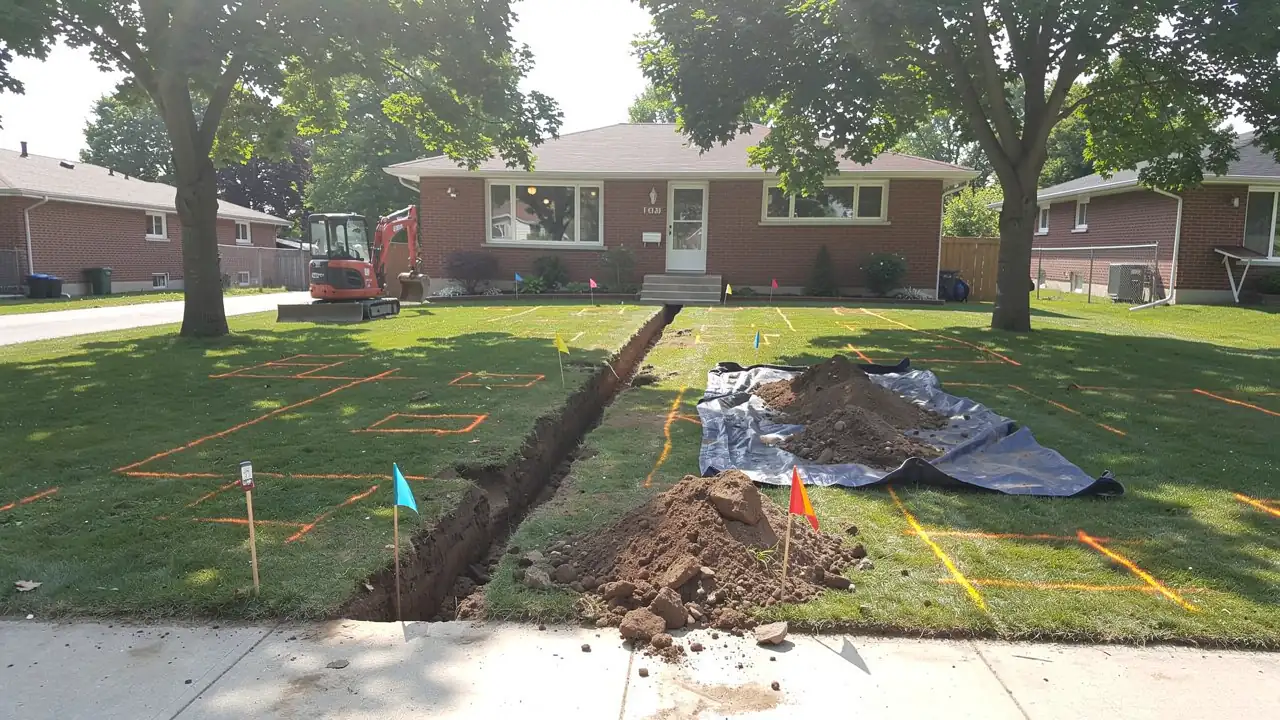


Mini excavator trenching water service in Guelph

Sewer Line Replacement, Water and Storm Line Excavation in Guelph

Guelph Excavation Pros digs and replaces the buried lines that serve a property: sanitary sewer laterals, water services, storm drains and electrical conduit. Homeowners call us after a sewer backup or a drop in water pressure, infill builders need new services for an added unit, and contractors book our trenching services when they would rather not run the dig themselves.

In 10+ years and 500+ jobs, much of our trenching has been beside live gas mains, hydro cables and fibre. That experience shows in the details: locates before the first bucket, hand or vacuum exposure of every crossing utility, and pipe laid to a measured slope rather than by eye.

Whether you need sewer line replacement, water line replacement, a new storm drain installation or a utility excavation for an EV charger, the trench stays open until the inspector signs off. Then we backfill in compacted layers and put the lawn or driveway back the way we found it.

Utility and Service Line Excavation Services

We excavate for five types of service line, most of them running between the house and the street. Many jobs combine two, such as a sewer lateral and a water service replaced in one trench so the yard is only opened once.

Rural homes on private services have a different set of buried lines, which we handle through our septic system excavation work.

Sanitary Sewer Lateral Replacement

A sewer lateral is the pipe that carries waste from your plumbing to the municipal sewer main under the street. We replace the private section from the foundation wall to the property line, cutting out cracked clay, cast iron or Orangeburg pipe and laying new PVC SDR 28 at a continuous slope.

When the connection at the property line is damaged as well, we coordinate timing with the City so both sections can be fixed while the trench is open.


Water Service Replacement and Upgrades

We replace old galvanized steel, lead and undersized 12 mm (1/2 in) copper water services with new 19 or 25 mm (3/4 or 1 in) Type K copper or polyethylene tubing. A larger service fixes low pressure when a family adds a bathroom, an irrigation system or a second unit.

Lead services are most common in Guelph homes built before the 1950s, and replacing the private side is the only permanent fix.

Storm Lines, Downspouts and Sump Discharge

Storm lines carry roof and sump water away from the house so it cannot soak back against the foundation. We trench solid PVC leaders from downspouts and sump discharge pipes to a swale, a dry well or a municipal storm connection where one is available.

Downspouts and sump pumps are not allowed to drain into the sanitary sewer in Guelph, and disconnecting them is a common fix for basements that back up during storms.

Hydro, Gas Preparation and Conduit Trenching

We dig trenches for buried power to detached garages, workshops, pool equipment and EV chargers, and prepare trenches for gas lines to outbuildings, heaters and standby generators. A licensed electrician or gas fitter lays and connects the line, and we backfill once it has been inspected.

Depth follows the Ontario Electrical Safety Code or the gas fitter's specification, typically 450 to 600 mm (18 to 24 in) for electrical, with warning tape set above the line.

New Service Connections for Infill and Additional Units

Adding a basement apartment, a garden suite or a second or third unit often means a larger water service and an upsized or separate sewer lateral. We excavate for the new connections to the approved servicing design and work around your plumber and the City inspections so the units can be occupied on schedule.

On tight infill lots we often combine this with site preparation for the new build, so one crew handles the dig from the street to the foundation.

Signs a Sewer or Water Line Needs Replacing

Repeated backups, roots in the line, low water pressure and an old pipe material are the four main signs a service line is due for replacement. A sewer camera inspection confirms the cause before anyone digs.

  • Backups that keep coming back. Snaking clears a clog for a few months, but a cracked or sagging lateral fills up again.
  • Tree roots in clay tile. Older laterals were built from short clay sections with open joints that roots find easily, especially under mature maples and willows.
  • Orangeburg pipe. This tar-soaked fibre pipe went into some homes built from the late 1940s to the early 1970s, and it slowly flattens into an oval.
  • Low or falling water pressure. Galvanized steel corrodes from the inside until the bore narrows, and a 12 mm line struggles to feed modern fixtures.
  • Lead water service. Found mostly in pre-1950s Guelph homes. Lead is dull grey, scratches to shiny silver with a key, and a magnet will not stick to it.
  • Wet, sunken or unusually green strips in the lawn. These often trace a leaking water line or broken sewer between the house and the street.

Not sure what you have? A plumber can check the pipe where it enters the basement, and a camera run through the cleanout shows the inside of the sewer lateral, including the distance to any break.

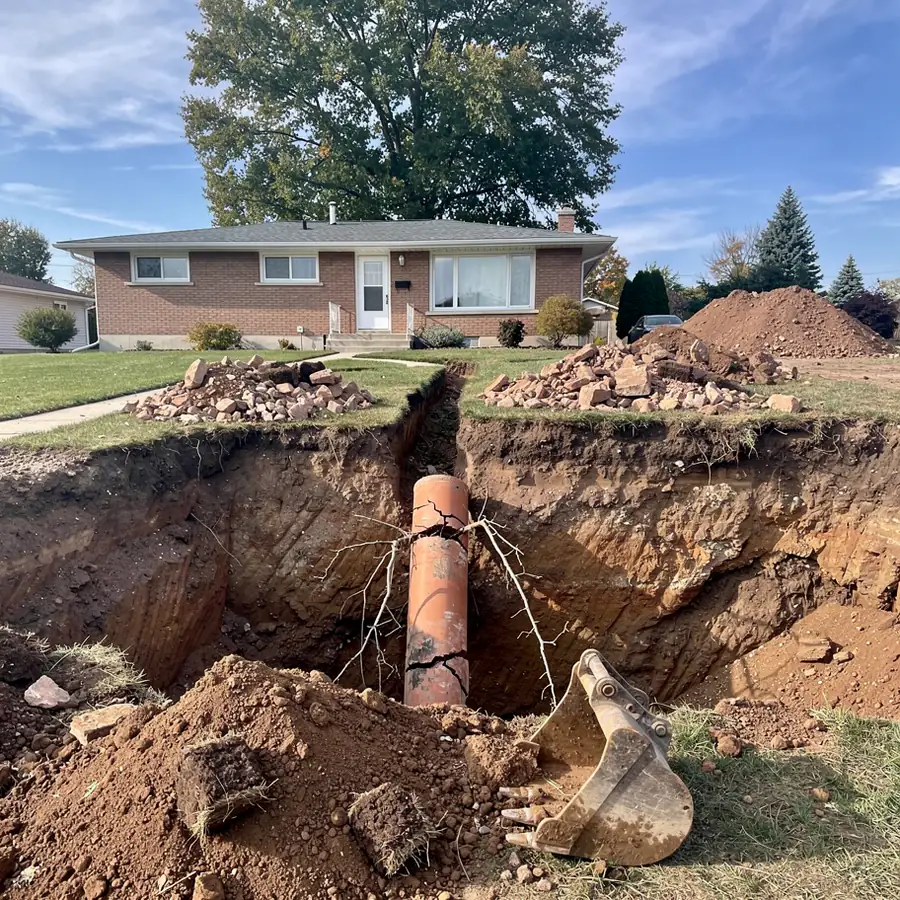
Old clay sewer lateral exposed in Guelph

Pipe Materials We Install

We install the pipe each line type is designed for, matched to the municipal standard and the Ontario Building Code. The table shows what goes in the ground and how long it should last.

Service line materials and expected lifespan
Line typeMaterial we installExpected lifespanNotes
Sanitary sewer lateralPVC SDR 28, usually 100 or 125 mm (4 or 5 in)75 to 100 yearsGasketed or solvent-welded joints resist roots; laid at about 2% slope
Water serviceType K soft copper or polyethylene water service tubing, 19 to 25 mm (3/4 to 1 in)50 to 75+ yearsOne continuous length from the property line to the house, so no buried joints
Storm and downspout linesSolid PVC, 100 mm (4 in)50+ yearsPerforated pipe only where the line is meant to soak into the ground
Electrical conduitRigid PVC conduit sized by the electrician50+ yearsLets cable be replaced later without digging; warning tape above
Gas line preparationTrench only; pipe supplied and installed by a licensed gas fitterSet by the pipe usedTracer wire and warning tape placed to the fitter's specification

Old materials we remove include vitrified clay tile, cast iron, Orangeburg fibre pipe, galvanized steel and lead. Removed lead and copper go to a metal recycler, not to landfill.

Who Owns the Line in Guelph

In Guelph, the City generally owns the sewer lateral and water service from the main under the street to the property line, and the homeowner owns everything from the property line to the house. Each side pays for repairs on its own section.

The property line on a water service is usually marked by the curb stop, a shut-off valve under a small metal cap in the lawn or boulevard, which only the City operates. We arrange a City shut-off before we cut into the water line.

When the camera shows the break is on the City side, the City handles that repair. When roots or a collapse are on private property, the owner hires a contractor, a plumbing permit is taken out and the owner pays for the work, which is where we come in.

Lead service and backflow prevention programs change from year to year, so check current details with the City of Guelph before you book.

How a Line Replacement Dig Works

A service line replacement follows five steps, from finding the problem to restoring the lawn. Most residential jobs take one to two days on site.

  1. Camera Inspection and Locates

    We start by finding the break, running a sewer camera through the cleanout to measure its distance and depth from the house. Then we request Ontario One Call locates, which are free and take up to 5 business days for a single address, and hire private locates for owner-installed lines such as gas to a garage or power to a shed.

  2. Open Trench or Daylighting Existing Utilities

    Every buried utility crossing the route is exposed by hand or by hydrovac (vacuum excavation) before a machine bucket gets close. Daylighting, which means digging down until you can see the pipe or cable, is the only way to confirm a locate mark is accurate.

    Once the crossings are visible, the excavator opens the trench. Wherever it is deeper than 1.2 m (4 ft), we set a trench box or slope the walls, as O. Reg. 213/91 requires.

  3. Bedding and Laying Pipe to Grade

    The trench floor is shaped and covered with bedding, usually Granular A or 19 mm clear stone, so the pipe sits on an even base with no rocks pressing on it. Sewer pipe is laid with a laser or a level at a constant slope of about 2%, or 20 mm per metre (1/4 in per ft), while water lines are set below frost depth.

  4. Inspection Before Backfill

    The trench stays open until the plumbing inspector has seen the new pipe, its slope and its connections. Covering a line before inspection can mean digging it up again, so we book the inspection as soon as the pipe is in.

  5. Backfill and Restoration

    We backfill in layers of about 300 mm (12 in), compacting each one so the trench does not sink next spring. Under driveways and walkways we use compacted Granular A up to the paving base, and on lawns we finish with screened topsoil and sod or seed.

    Where a driveway was cut, our driveway excavation and preparation crew rebuilds the base properly before it is paved.

Frost Depth and Bedding Standards

Water services around Guelph need at least 1.5 m (5 ft) of cover, and municipal standards can call for more, so the line stays below the frost that drives deep into clay soil in a cold winter. A service laid too shallow can freeze solid in February, usually under a snow-cleared driveway where frost goes deepest.

Sewer laterals are sloped rather than set at one depth, so they often end up deeper than the water line at the street. Where a lateral must stay shallow, for example to serve a low basement drain, we lay rigid foam insulation board above the pipe.

Bedding and cover follow the Ontario Provincial Standard Specifications (OPSS) and the City's standard drawings: a granular bed under the pipe, about 300 mm of granular cover over it, then native backfill. Inexperienced crews skip that cover layer and drop clay chunks straight onto the pipe, which cracks PVC and leaves voids that settle.

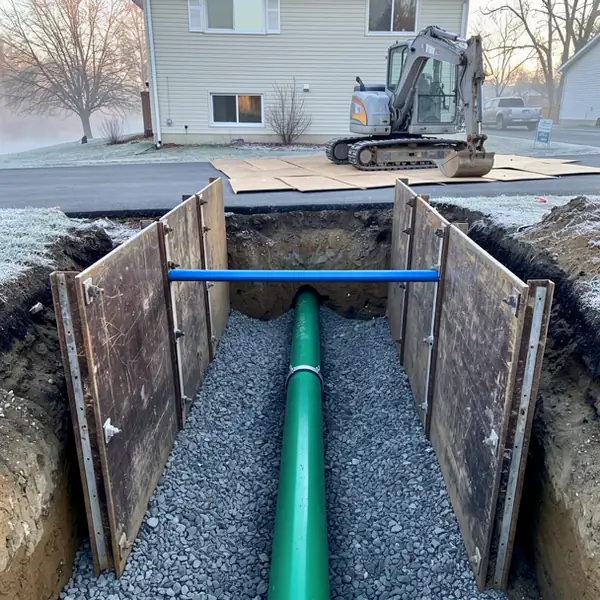
New PVC sewer lateral bedded in Guelph

Line Excavation Cost Factors

A residential sewer lateral replacement in Guelph typically costs $6,000 to $15,000 and a water service replacement $4,000 to $10,000, with open-trench work running about $250 to $600 per metre. Replacing both in one shared trench usually costs 25 to 40% less than doing them separately.

Your written quote is fixed after a site visit and a camera inspection, so the price is set before digging starts.

What changes the cost of a service line dig
Cost driverWhat changesTypical effect on price
Length of the runDistance from the foundation wall to the property lineMany Guelph laterals run 8 to 20 m; each extra metre adds about $250 to $600
DepthDeeper lines need more digging, shoring and backfillLines over about 2.5 m deep may need a trench box and a larger machine
Driveway, walkway or tree in the waySaw-cutting and rebuilding hard surfaces, or working around rootsDriveway restoration adds $1,500 to $5,000 depending on width and finish
Rock or bouldersGlacial till and shallow limestone in parts of Guelph slow the digHydraulic breaker time adds $150 to $250 per hour
Permit feesPlumbing permit, road occupancy or City-side connection chargesUsually a few hundred dollars; City-side work may be billed separately
Work inside the houseCutting the basement floor to replace pipe under the slabQuoted with your plumber; adds about $1,500 to $4,000

If the trench crosses a concrete walkway or patio, we cut and lift it cleanly with our concrete breaking and removal equipment and replace the base before it is re-poured.

Sewer and Water Line FAQs

How deep are water lines buried in Guelph?

Water services in Guelph are typically buried with at least 1.5 m (5 ft) of cover, and often more, to keep them below winter frost. Older homes sometimes have shallower lines, which is a common reason a service freezes during a cold snap.

When we replace a service, we set it to today's required depth even if the old line was higher.

Who pays to fix a sewer lateral in Guelph?

The homeowner pays for the private section from the house to the property line, and the City generally covers the section from the property line to the main. The camera inspection decides which side the repair falls on, because it shows exactly where the break sits.

Policies can change, so confirm the current split with the City of Guelph before work is booked.

Will you need to dig up my driveway?

Sometimes, because many lines run straight under the driveway to the street. We can often avoid a full cut by routing the new pipe around it, or by boring a water service underneath with a pneumatic piercing tool or a directional drill.

When a cut is the only option, we saw-cut a neat strip, rebuild the base with compacted Granular A and leave it ready for patching.

How long will I be without water or sewer?

Most single-line replacements leave a home without that service for about 6 to 10 hours on one working day. We dig, expose the crossings and prepare the bedding before the old line is cut, so the outage only covers the swap and the inspection.

On a longer job, we plan a temporary water supply with your plumber so the house is not left dry overnight.

How do you dig safely around gas lines?

We have the line located through Ontario One Call, then expose it by hand or hydrovac anywhere inside the tolerance zone, the strip about 1 m either side of the locate marks where machine digging is not allowed. Only once the gas line is visible does an excavator work near it, with a spotter watching the bucket.

Line Work Across Guelph, Kitchener, Waterloo and Cambridge

We replace sewer and water lines across Guelph and Waterloo Region, within about a 30-minute drive of our yard. Ownership and permit rules differ by municipality, so we confirm them for your address before quoting.

In Kitchener and Waterloo, the Region of Waterloo owns the water supply and trunk sewers while each city runs its local mains and service connections, and Kitchener Utilities manages water within Kitchener. The property-line split and the office that inspects your connection are not the same as in Guelph.

Guelph

Lateral and lead water service replacement in older neighbourhoods such as the Ward and Exhibition Park, part of our excavation services in Guelph.

Waterloo

Service upgrades for added units and replacement of aging laterals in Waterloo neighbourhoods around Uptown and the universities.

Book a Line Replacement Quote

Send us what you know about the line, and we will explain what the dig involves and what it will cost. You get a fixed written quote after we have seen the site.

  • Camera inspection footage or your plumber's report, if you have one
  • Your property address
  • Symptoms such as backups, low pressure or wet spots, and when they started
  • The approximate age of the house and any past line repairs
  • Photos of the route from the house to the street, including the driveway and any trees

For a backup or burst line, call 548-918-0387; the phone is staffed 6:00am to 9:00pm Monday to Saturday and from 9:00am on Sunday.

Open Monday to Saturday 6:00am to 9:00pm and Sunday 9:00am to 9:00pm.

Call 548-918-0387Free Quote