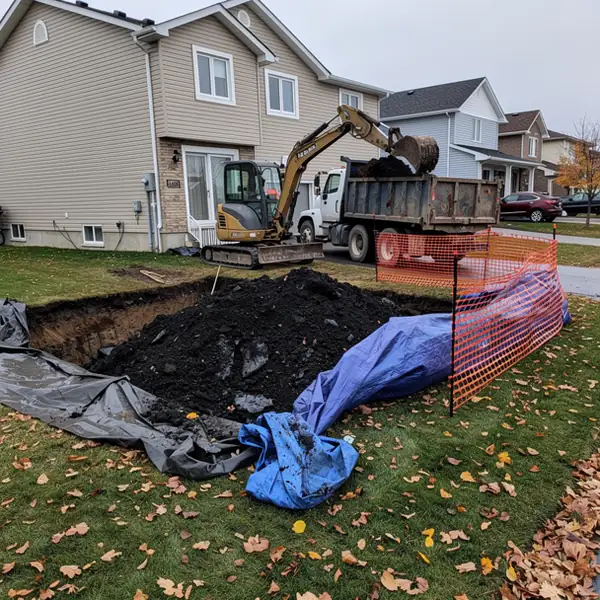
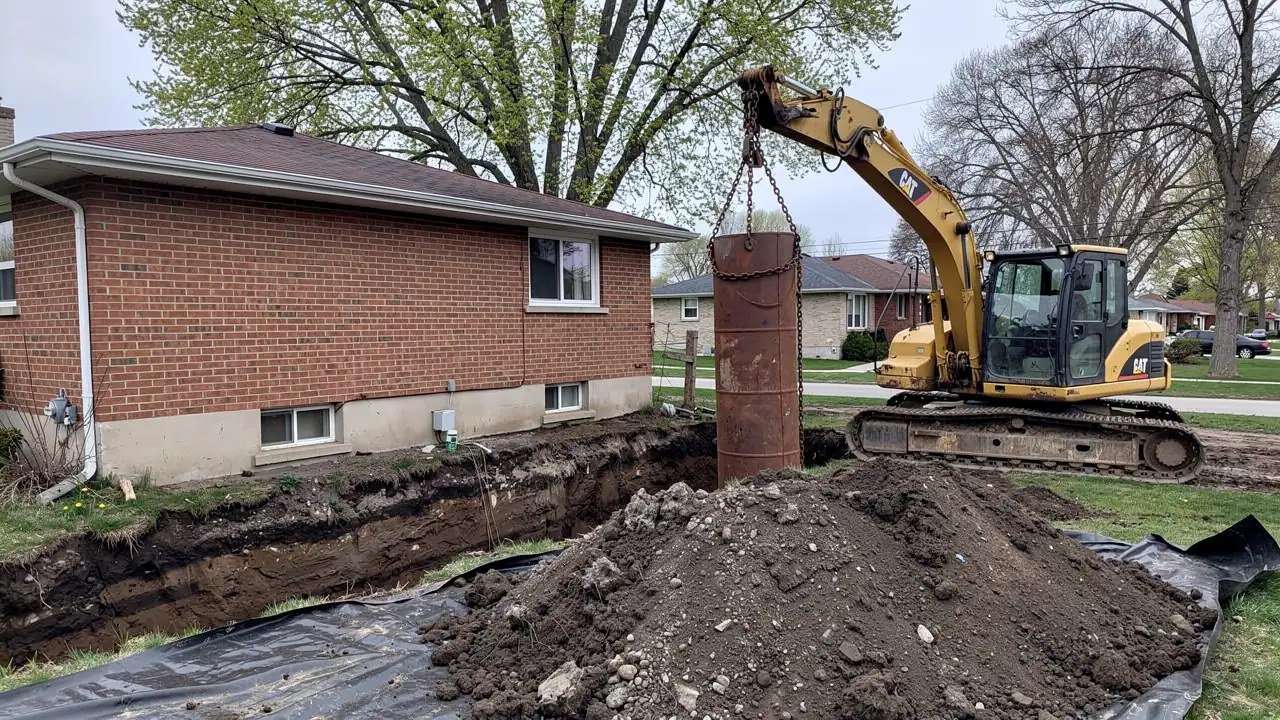
Excavator lifting oil tank from Guelph yard

Oil Tank Removal and Contaminated Soil Removal in Guelph

Guelph Excavation Pros digs out and removes old fuel oil tanks, buried in the yard or sitting in the basement, and excavates any soil a leaking tank has stained. We work for home buyers and sellers facing a closing date, owners whose insurer has sent a removal letter, households converting from oil heat to a heat pump or natural gas, and commercial owners cleaning up a property before a sale.

Underground oil tank removal is more than a dig. The tank has to be emptied by a fuel contractor, lifted without splitting the shell and the tank bed sampled so a lab can confirm the soil is clean. When it is not, we carry out the contaminated soil removal to the limits the environmental consultant sets.

Guelph draws nearly all of its drinking water from wells, so a leaking fuel tank here is a groundwater issue as well as a property issue. With 10+ years and 500+ jobs behind us, we run every fuel tank removal as a tidy, documented job, so your insurer, lender or buyer gets the paperwork they ask for.

Oil Tank and Contaminated Soil Services

We handle five kinds of tank and soil work, from a single basement tank to a buried tank with stained ground around it. Most jobs combine two or three of them in one visit.

Underground Oil Tank Removal

Buried residential tanks in Ontario are usually single-wall steel, 900 to 2,300 L (200 to 500 gal), set 0.6 to 1.5 m (2 to 5 ft) below grade near the foundation. We uncover the top, have the tank emptied, then dig around the shell and lift it out with the excavator.

Tanks under a patio or driveway need the surface broken out first, which our concrete breaking and removal crew does on the same visit.

Finding Abandoned Tanks

Many Guelph houses built before the 1970s were heated with oil, and some buried tanks were simply left behind when the house switched to gas. The usual clues are a capped pipe in the lawn or foundation wall, old copper fuel lines through the basement wall and a furnace room with a concrete burner pad.

When the clues point to a tank but nobody knows where it sits, a metal detector or ground-penetrating radar (GPR) scan narrows the search before we dig a test hole. That keeps the yard intact and the excavation small.

Basement and Above-Ground Tank Removal

Indoor tanks are usually 909 L (200 gal) steel tanks on legs, in a basement, garage or shed. Once the fuel contractor drains and disconnects it, the tank is carried out whole or cut into sections after it has been cleaned and made vapour-free.

We also remove or cap the outside fill and vent pipes. A fill pipe left in the wall is how a delivery driver ends up pumping heating oil into an empty basement.

Contaminated Soil Excavation and Disposal

If the tank leaked, we dig out the stained soil in stages, stockpile it on poly sheeting under a tarp and load it for a licensed hauler. The consultant samples the walls and floor of the pit after each stage until the results meet the clean-up standard.

Bigger volumes are handled by the same trucks and operators who run our earthmoving and soil removal jobs.

Clean Backfill and Restoration

The open hole is filled with tested clean fill or Granular B and compacted in 300 mm (12 in) lifts, so the lawn or driveway does not sink next spring. We finish with topsoil and seed or sod, and set the surface to drain away from the house using the same methods as our grading and levelling service.

Why Old Oil Tanks Are a Risk in Guelph

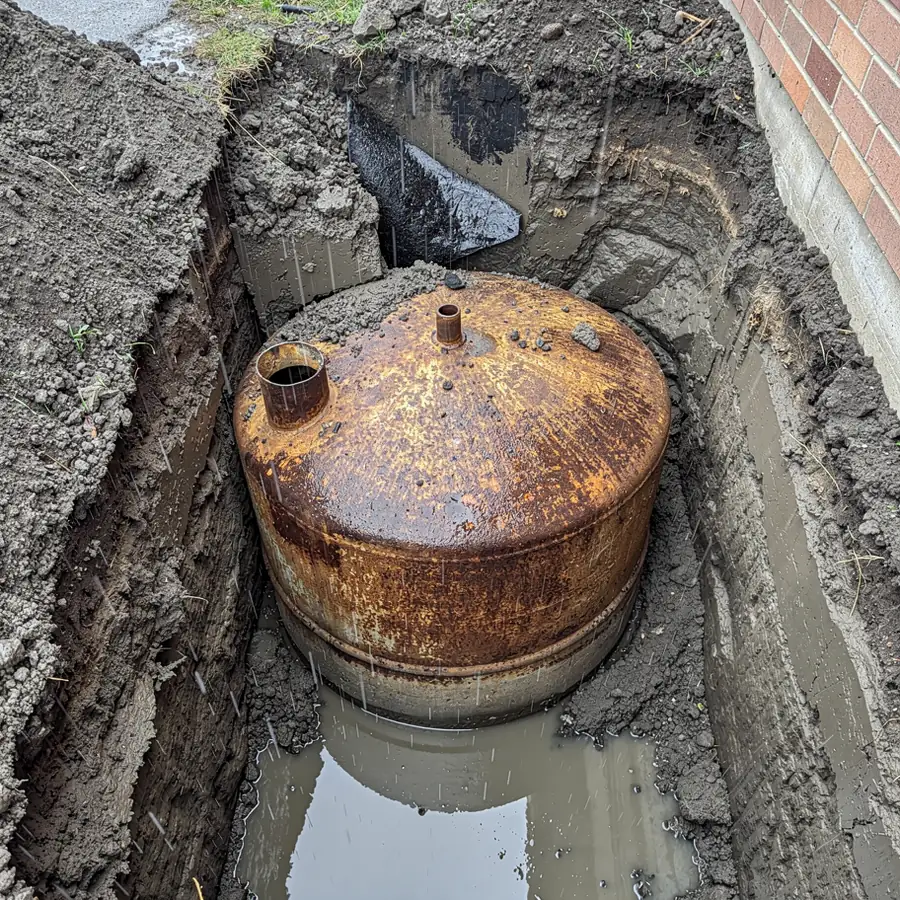
An old oil tank is a risk because steel rusts from the outside in, and a slow leak can run for years before anyone notices. By the time a buyer's home inspector or an insurer asks about the tank, the problem is often already in the soil around it.

Guelph adds a local reason to act. The city is one of the largest communities in Canada that relies almost entirely on groundwater, and the handling and storage of fuel is a listed drinking water threat in the source protection plan the City enforces through its source water protection program.

In wellhead protection areas, fuel storage can bring risk management rules with it. Removing a tank you no longer use ends that exposure for good.

  • Leaks: pinhole corrosion along the bottom seam or a cracked supply line lets oil seep into the clay till around the tank.
  • Insurance refusals: many Ontario insurers will not cover a home with a buried tank, and some set an age limit, often 25 years, on steel indoor tanks.
  • Failed home sales: a buyer's lawyer or lender can hold up a closing until there is a removal record and clean soil results.
  • Liability: an owner can be held responsible for cleaning up oil that has spread under a neighbour's property.
Corroded buried oil tank uncovered in Guelph

TSSA Rules for Fuel Oil Tank Removal

In Ontario, fuel oil tanks fall under O. Reg. 213/01 (Fuel Oil), which the Technical Standards and Safety Authority (TSSA) enforces. The regulation adopts the CSA B139 installation code for oil-burning equipment, with Ontario changes, and those rules say when a tank must come out and who may do the work.

  • An underground tank that is no longer in use must be removed, generally once it has been out of service for two years.
  • The tank, its piping and the fuel side of the job must be handled by a TSSA-registered fuel oil contractor using certified technicians.
  • Leaving a buried tank in place is accepted only where removal is not practical, such as a tank under a building, and the tank must then be emptied, cleaned and filled with an inert material.
  • Any leak found while the tank is coming out has to be dealt with before the hole is backfilled.

On our jobs, the pump-out, disconnection, tank cleaning and removal record are done by a TSSA-registered fuel oil contractor, and our crew does the excavation, lifting, soil handling and restoration. You get one schedule and one point of contact for the whole job.

Commercial and farm tanks that held gasoline or diesel fall under a different regulation, O. Reg. 217/01 (Liquid Fuels), and we quote those after reviewing the site records.

Soil Testing and Environmental Assessment

Soil testing is what turns a tank removal into a clean record. Every removal ends with lab results from the tank bed, and some commercial sales need a formal Environmental Site Assessment (ESA) on top.

We work with independent environmental consultants for sampling and reports, so the results come from a qualified third party rather than the crew that dug the hole.

Soil Sampling at Removal

Once the tank is out, samples are taken from the floor and walls of the excavation and sent to a CALA-accredited lab. The usual test suite covers petroleum hydrocarbons (PHC fractions F1 to F4) and BTEX (benzene, toluene, ethylbenzene and xylenes).

Results are compared with the soil standards under O. Reg. 153/04. Standard turnaround is about 5 business days, and rush results in 24 to 48 hours cost extra.

Phase One and Phase Two ESAs

A Phase One ESA reviews records and the site to flag possible contamination, such as a former fuel tank. A Phase Two ESA then samples soil and groundwater to confirm what is actually there.

Commercial buyers and lenders usually ask for one or both before financing a property with a history of fuel storage. Where a Record of Site Condition is needed, a Qualified Person under O. Reg. 153/04 must do the work, and we dig the test pits and any clean-up they call for.

Reporting Spills

A fuel oil spill that could harm the natural environment must be reported to Ontario's Spills Action Centre at 1-866-663-8477, which answers 24 hours a day. Under Part X of the Environmental Protection Act, the duty falls on the owner and on whoever had control of the oil.

If we open a pit and find free oil or a sheen on groundwater, we stop, contain it and make the call with you. Reporting early is the law, and it keeps the clean-up straightforward.

Our Tank Removal Process

Most residential tank removals follow five steps and finish in one working day when the soil is clean. Contamination adds days to the schedule, rarely weeks.

  1. Locate and Assess

    We confirm the tank's position from the fill and vent pipes, probe or scan to find both ends and request Ontario One Call locates, which take 5 business days for a single address. We also plan the machine route, the spoil pile and where the truck will park.

  2. Pump Out Remaining Fuel

    A licensed fuel contractor pumps the leftover oil and sludge into a vacuum truck and disconnects the lines. Old tank oil is usually mixed with water and sediment, so it goes for disposal rather than back into a furnace.

  3. Excavate and Lift the Tank

    We dig beside the tank rather than over it, so the bucket teeth never strike the shell. The tank is opened, cleaned and vented, lifted out with chains or slings and hauled to a scrap yard that accepts fuel tanks.

  4. Test and Remove Impacted Soil

    The consultant samples the pit, and if the lab shows impact, we dig in stages to the clean limits the results set. Impacted soil is kept apart from clean soil and covered until it is hauled away.

  5. Backfill and Documentation

    We backfill with clean fill, compact in lifts and restore the lawn, garden or driveway. You receive the removal record, lab results and disposal receipts, the package insurers and buyers' lawyers ask for.

Where Contaminated Soil Goes

Contaminated soil goes to a facility licensed to receive it, never to a farm field or a fill site. Petroleum-impacted soil from tank removals is usually taken to a landfill or soil treatment facility that holds an Environmental Compliance Approval from Ontario's Ministry of the Environment, Conservation and Parks.

Before it moves, the soil is characterised by lab testing, including a leachate test under O. Reg. 347, to show whether it is hazardous or non-hazardous waste. Hazardous loads travel on an electronic manifest filed in the Resource Productivity and Recovery Authority (RPRA) registry, which tracks each load from your property to the receiver.

Clean soil dug out alongside the tank is excess soil under O. Reg. 406/19, On-Site and Excess Soil Management, which controls where it may be reused. Larger projects file notices in the RPRA Excess Soil Registry, and we keep every weigh ticket and manifest for your final report.

Excavator loading contaminated soil in Guelph

Oil Tank Removal Cost Factors

A typical residential underground oil tank removal in Guelph costs $3,000 to $6,000 when the soil is clean, and a basement tank removal usually runs $800 to $2,000. If the tank has leaked, contaminated soil removal can add $5,000 to $30,000 or more, depending on how far the oil has travelled.

The base figures include the excavation, fuel contractor, tank disposal, standard soil tests and clean backfill. We fix the price in a written quote after a site visit, and any contaminated soil is priced per tonne so you can see exactly what you are paying for.

What moves the price of an oil tank removal
Cost driverWhy it mattersTypical effect on price
Tank size and typeBigger buried tanks need a larger hole and more backfillA 2,300 L tank costs more to pull than a 900 L tank
Tank locationTanks under decks, patios, driveways or close to footings need surface removal or slow, careful diggingAdds $500 to $3,000
Machine accessNarrow side yards need a mini excavator and more hand diggingAdds about half a day
Leftover fuel and sludgePump-out and disposal of old oil and water$300 to $800
Soil testingLab analysis of tank bed samples, with rush fees when a closing date is near$400 to $1,200
ContaminationExcavation, hauling and tipping of impacted soil at a licensed facility$100 to $200 per tonne disposed
RestorationTopsoil and sod, or reinstating asphalt, concrete or interlock$500 to $4,000

Commercial tanks, tanks under buildings and Phase One or Phase Two ESAs are quoted separately. A residential Phase One ESA alone usually costs $2,000 to $5,000.

Oil Tank Removal FAQs

Straight answers to the questions Guelph homeowners, buyers and property managers ask us most about fuel tanks and soil.

How do I know if my house has a buried oil tank?

Look outside for a capped fill pipe near ground level and a vent pipe with a mushroom-shaped cap, usually within a few metres of the foundation. Inside, copper lines or patched holes through the basement wall and a flue sized for an oil furnace are other signs.

Old furnace service records, oil delivery receipts and the seller's disclosure can confirm it. If you are still unsure, a GPR scan settles the question before you buy.

Will my insurance cover oil tank removal?

Usually not. Insurers treat removal as maintenance, yet many require the tank to be gone before they will issue or renew a home policy.

Some policies cover a sudden spill but exclude gradual leaks, which is how most old tanks fail. Ask your broker for the requirement in writing and send us the letter, so the removal record matches what they need.

Do I have to remove an unused oil tank before selling?

If it is a buried tank that has been out of service, Ontario rules already require removal, sale or no sale. For an indoor tank, no rule is tied to the sale, but buyers, lenders and insurers usually make removal a condition.

Removing the tank before you list, with soil results in hand, avoids a last-minute price cut or a delayed closing.

What happens if the soil is contaminated?

We dig out the impacted soil, the consultant retests the pit and the cycle repeats until the results meet the standard. The soil goes to a licensed facility, the hole is backfilled with clean fill and you receive the lab results and disposal records.

If oil has reached groundwater or run under the house, the consultant designs a larger remediation plan, which we price separately.

How long does oil tank removal take?

A residential tank with clean soil takes one day on site, after the 5 business days needed for Ontario One Call locates. Standard lab results come back about a week later.

Contaminated jobs usually add 1 to 5 days of digging, and the pit may stay fenced and covered while confirmation samples are tested.

Tank Removal in Guelph and Waterloo Region

We remove oil tanks across Guelph and the towns within about 30 minutes of our yard. Kitchener, Waterloo and Cambridge draw much of their water from Region of Waterloo wells, so their wellhead protection areas raise the same worry about leaking fuel that Guelph has.

Guelph

Older neighbourhoods such as St. George's Park, Exhibition Park and the Ward still have houses with oil tanks from their furnace years. Read about our excavation services in Guelph.

Cambridge

Pre-war homes in Galt, Preston and Hespeler are common places to find a forgotten buried tank. See our excavation work in Cambridge.

Kitchener

Regional wellhead protection areas reach into parts of Kitchener, which makes a properly documented removal worth the effort. More on excavation in Kitchener.

Waterloo

Older houses around Uptown Waterloo sometimes still hide a basement tank behind the furnace room wall. Visit our Waterloo excavation page.

Puslinch

Puslinch homes rely on private wells, so a leaking tank can foul the owner's own water supply. Farmhouses here often have tanks nobody has checked in decades; see excavation in Puslinch Township.

Milton

Rural properties near Campbellville and along the escarpment are on private wells and often older oil-heated farmhouses. Our Milton excavation services page has the local detail.

Book an Oil Tank Removal

Call 548-918-0387 or send the details below, and we will book a site visit and give you a written quote for the tank removal. If a closing date or insurance deadline is driving the job, tell us the date first so we can plan locates and lab turnaround around it.

  • Where the tank is: buried outside, in the basement or in a garage or shed
  • Approximate age and size of the tank, if you know them
  • Photos of the fill pipe, vent pipe and the yard or room around them
  • Your insurer's or lender's letter, if you have one
  • Any closing date, home inspection report or earlier soil results

Open Monday to Saturday 6:00am to 9:00pm and Sunday 9:00am to 9:00pm.

Call 548-918-0387Free Quote