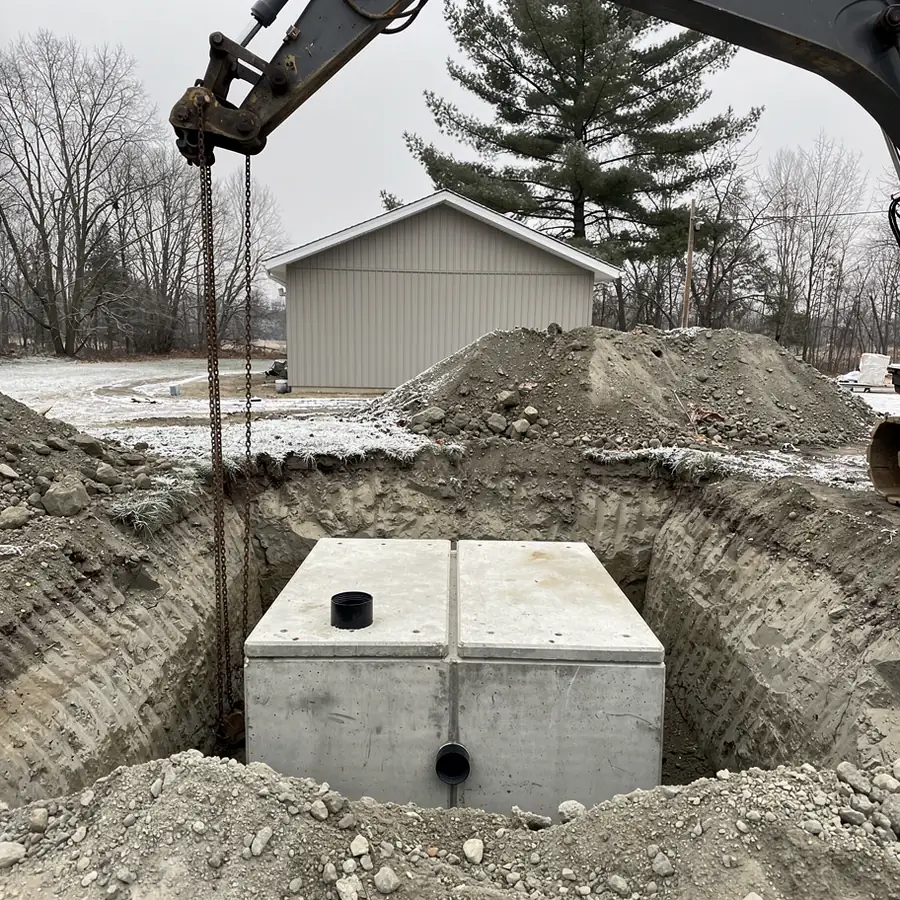
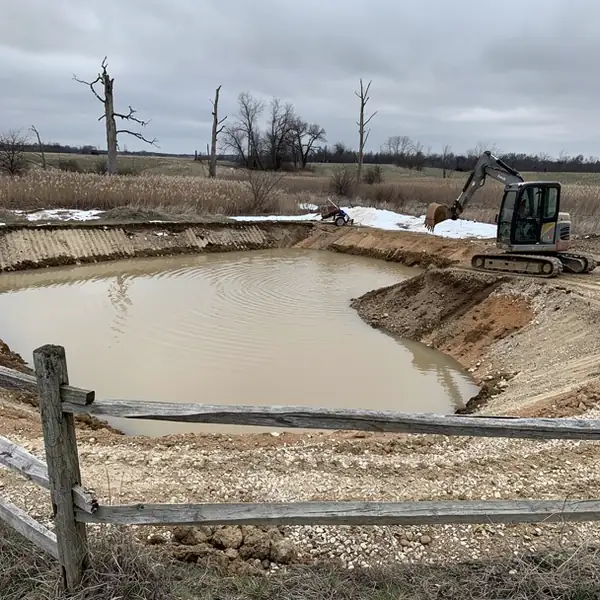
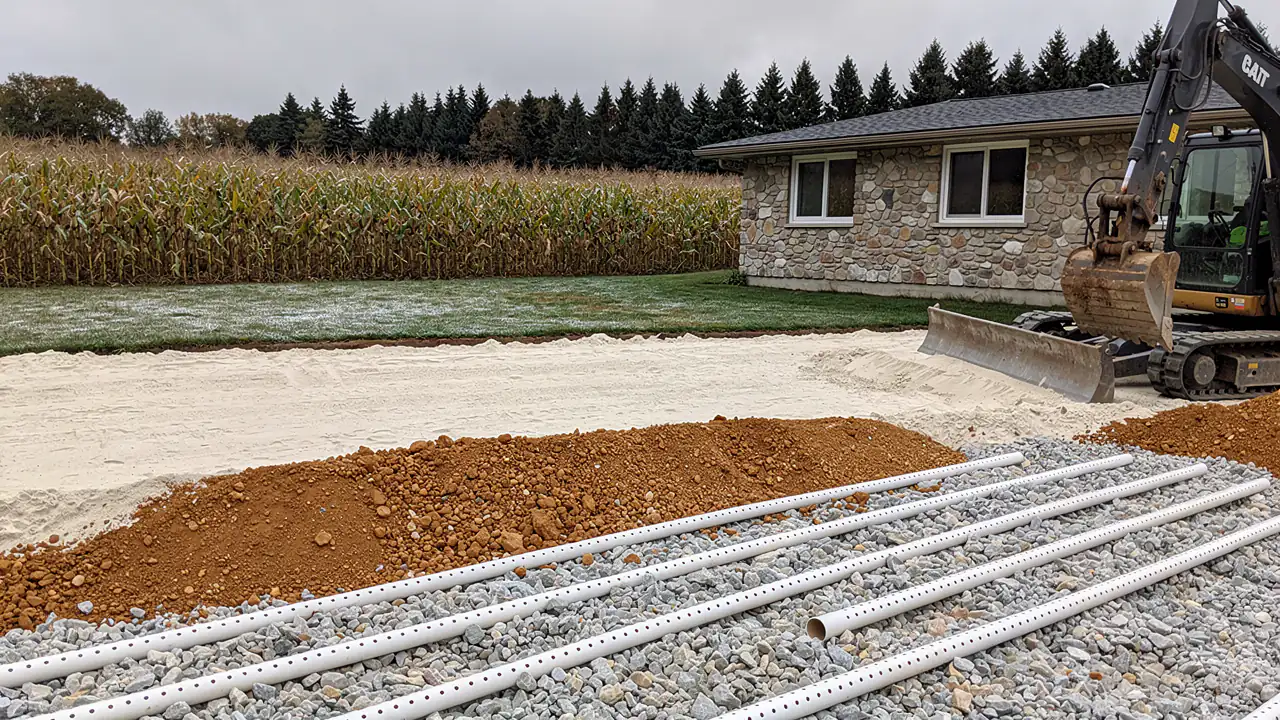
Excavator building septic bed in Puslinch

Excavation in Puslinch Township: Septic, Grading and Rural Lot Prep

Guelph Excavation Pros is an excavation contractor based just north of Puslinch, about 15 minutes up the Hanlon Expressway from Aberfoyle. We dig septic systems, driveways, ponds, building pads and foundations for rural homeowners, farms and small builders across the township. More than 500 jobs over 10+ years have taught us how differently a Puslinch lot behaves from a city lot.

Almost every Puslinch home runs on a private well and a septic system, so nearly every dig here involves Part 8 of the Ontario Building Code and the distance to someone's drinking water. The township also sits on some of the deepest sand and gravel in Ontario, which is why licensed aggregate pits cluster along Highway 6 around Aberfoyle and Morriston.

That gravel drains beautifully but can pass septic effluent too fast, while the wetlands around Puslinch Lake and Mill Creek bring groundwater close to the surface. Our septic installation work in Wellington County, from tank swaps to new Class 4 systems, is planned around both.

Rural Excavation Work We Do in Puslinch

Puslinch work is rural work: long haul roads, wells to protect, and soils that change from clean gravel to wet muck within one property. These are the four job types we quote most often in the township.

Septic Systems for Homes on Private Services

We excavate septic tank swaps, leaching bed replacements and complete new systems for homes on private services. Typical scopes are replacing a rusted steel or cracked concrete tank with a two-compartment precast tank, rebuilding a saturated bed, or building a raised bed on imported sand.

Our septic system excavation crews work to the permit drawings and the Township's inspection schedule. When a system moves, the old tank is pumped and either removed or filled with sand or clear stone, as the Township requires.

Long Driveways and Country Lot Clearing

Puslinch lots often need 60 to 300 m of driveway, a culvert at the road ditch and a building envelope cleared through cedar or mixed bush. We strip topsoil, lay geotextile on soft subgrade and build up about 300 mm of Granular B under 150 mm of Granular A, compacted in lifts.

A new or moved entrance needs a permit from the road owner: the Township for local roads, Wellington County for roads such as Wellington Road 34 and 46, and the Ministry of Transportation on Highway 6. Our driveway excavation and preparation and site preparation and land clearing services cover the full build.

Ponds, Drainage and Outbuilding Pads

Farm and recreational ponds, swales, tile outlets and level pads for shops, barns and riding arenas are a large share of our Puslinch work. A typical shop pad is cut to firm subgrade, built up with 300 to 450 mm of compacted Granular B and capped with Granular A for the slab or post frame.

Ponds need the most planning, since a dug pond can intercept the water table or sit in a regulated area. We test-pit first, then shape side slopes of about 3 to 1 for stability; our pond excavation page covers the build.

Additions and New Custom Homes

Foundations for custom homes and additions on Puslinch lots carry one extra constraint: the well and septic must stay in service, at legal distances, through construction. We stake the well, tank and bed before digging so no machine tracks over a leaching bed or stockpiles soil on it.

A full basement usually means digging 2.4 to 2.7 m (8 to 9 ft) below grade, and in deep gravel the walls can often be sloped instead of shored. See our foundation excavation service for footings and inspections.

Puslinch Septic Permits and Part 8 Rules

The Township of Puslinch building department issues the permit for any new, repaired or altered sewage system, and applications go in online through CloudPermit. Once an application is complete, the Township reviews it within 10 business days, according to its January 2026 On-Site Sewage System Information Guide.

Part 8 of the Ontario Building Code sets the design and installation rules, and both the designer and the installer must be qualified under the Building Code Identification Number (BCIN) system. A complete Puslinch application includes:

  • A scaled site plan or survey showing every new and existing sewage component, buildings, decks, pools and all known wells
  • Test pit locations and distances to property lines, structures, water bodies and any well within 30 m
  • A Class 4 design with at least one test pit at the bed, groundwater and bedrock elevations, SB-6 particle size lab results, a design percolation time and daily design flow
  • A Schedule 1 form for the designer and a Schedule 2 form for the installer, updated before construction if the installer is named later
  • A full grading plan if the lot is in a plan of subdivision

Three inspections follow: the base cut before sand or stone goes down, a check of the installed components before backfill, and a final once grading is done, grass is established and tank lids are at grade. Puslinch does not permit holding tanks, and an advanced treatment unit needs a servicing agreement with a person the manufacturer authorises.

Read the Township of Puslinch sewage system information guide and the Puslinch building department page before applying. We plan dig dates around the Township's inspection days of Monday, Wednesday, Thursday and Friday, booked by 3:00pm the business day before.

Precast septic tank set in Puslinch gravel

Gravel, Till and Water: Puslinch Ground Conditions

Puslinch has three main ground conditions, and each one changes the septic design. The Paris and Galt moraines cross the township from northeast to southwest, leaving thick sand and gravel, patches of stony till and low, wet ground between the ridges.

How Puslinch ground conditions affect septic and excavation work
Ground typeWhere you find itWhat it means for septic and digging
Deep sand and gravelAberfoyle, Morriston and the Highway 6 corridor near the aggregate pitsDigs and drains easily, but very fast soil can pass effluent before it is treated, so designs often add an imported sand layer under the bed
Stony silt tillHigher ground between the moraines, including parts of Badenoch and CrieffSlower percolation, so beds may be larger or raised; footings sit on firm bearing
High water table and organic soilAround Puslinch Lake, Mini Lakes and the Mill Creek wetlandsThe bed needs at least 900 mm of unsaturated soil above groundwater, which usually means a raised bed and pumping the dig dry

We dig the designer's test pits with our own machine, usually 2 to 3 m deep, so the soil profile and seasonal water marks can be logged. Near Mill Creek a spring test pit can take on water fast, and that tells the designer something useful.

Where a lot borders a licensed pit or an old extraction area, we also check for disturbed ground or past fill before a bed or footing is placed.

Conservation Authority Areas in Puslinch

Puslinch is served by three conservation authorities: the Grand River Conservation Authority (GRCA), Conservation Halton and the Hamilton Conservation Authority. Which one regulates your lot depends on the watershed it drains to, and each issues its own permits under O. Reg. 41/24.

Most of the township, including Aberfoyle, Puslinch Lake and the Mill Creek system, drains to the Grand River under the GRCA. The southeastern corner drains toward Spencer Creek under the Hamilton Conservation Authority, and land along the eastern edge drains toward Conservation Halton's watershed.

Septic beds, ponds, fill and building pads near the Mill Creek wetlands or the Puslinch Lake shoreline usually need a permit before the Township issues a building permit. We confirm the authority and regulated limit for your lot at the quote stage; the GRCA permit information is the place to start for most of the township.

Farm pond dug near Puslinch wetland

Protecting Wells and the Arkell Spring Grounds

Puslinch holds drinking water for its own residents and for the City of Guelph. The City's Arkell Spring Grounds, a Guelph supply in use since the early 1900s, sit in the township's northeast, and the protection areas around Guelph's wells reach onto Puslinch farms and rural lots.

In those areas, building permits are screened through the County's source water program, and activities such as fuel storage may need a risk management plan. Check your address with Wellington Source Water Protection before a large dig.

Private wells get the same care. The Township asks for every well within 30 m of a proposed system, including your neighbours', because Part 8 clearances apply to all of them.

On every Puslinch job we refuel on a drip tray well away from any wellhead, keep spill kits on the machines and never stockpile soil or fuel over a well. Where a well sits close to the work, we fence it off before the first bucket goes in.

Puslinch Hamlets and Communities We Serve

We cover every corner of Puslinch Township, and most sites are 15 to 25 minutes from our Guelph yard via the Hanlon Expressway, Highway 401 or Victoria Road South. Trucks hauling tanks or stone take a few minutes longer.

Approximate drive times from our Guelph yard
CommunityDriveCommon jobs
Aberfoyle15 minSeptic replacements, driveways, additions
Morriston20 minSeptic on older village lots, shop pads
Arkell20 minCustom homes, grading, ponds
Badenoch20 minLong driveways, barn and outbuilding pads
Crieff25 minFarm ponds, lot clearing, new homes
Killean25 minSeptic systems, drainage swales
Puslinch Lake20 minRaised septic beds, permitted shoreline work
Mini Lakes20 minTight-access digs and service repairs

Working this close means a short call-out when a tank backs up or a culvert washes out after a storm.

Typical Puslinch Excavation Projects

These are the Puslinch projects we quote most often, with typical price ranges and durations. Every job gets a fixed written quote after a site visit and a look at the soil.

Typical Puslinch excavation costs (CAD, before tax)
ProjectTypical rangeTypical duration
Septic tank replacement$6,000 to $12,0001 to 2 days
In-ground leaching bed replacement$15,000 to $30,0003 to 5 days
New Class 4 system with raised bed$28,000 to $50,0005 to 8 days
Gravel driveway, about 100 m with culvert$10,000 to $22,0002 to 4 days
Farm or recreational pond$8,000 to $30,0002 to 6 days
Shop or barn pad$5,000 to $15,0001 to 3 days

Costs rise with imported sand volume, dewatering and conservation authority conditions. They drop when on-site gravel can be reused, and short hauls from nearby pits keep Puslinch stone prices lower than in many areas.

Puslinch Excavation FAQs

Straight answers to the questions Puslinch property owners ask us most.

Who issues septic permits in Puslinch?

The Township of Puslinch building department issues all sewage system permits, for new systems, repairs and alterations. Apply online through CloudPermit with a site plan, a Class 4 design and the Schedule 1 and 2 forms; complete applications are reviewed within 10 business days.

How far does a septic bed need to be from my well?

Under Part 8, a leaching bed must be at least 15 m from a drilled well with a watertight casing to at least 6 m depth, and 30 m from any other well, such as a dug well. The septic tank must be at least 15 m from a well.

The bed must also stay 15 m from a lake, pond or stream. Our septic installation page has the full clearance table.

Can you work near Puslinch Lake?

Yes. Lots around Puslinch Lake usually need a GRCA permit for septic, grading or fill work, and the high water table often calls for a raised bed and pumping water out of the dig.

We schedule lakeside work for drier months, usually July to October, and keep silt fence between the excavation and the water.

How quickly can you get to Aberfoyle or Morriston?

About 15 minutes to Aberfoyle and 20 minutes to Morriston from our Guelph yard on a normal weekday. For an urgent septic or drainage problem, call 548-918-0387 and we will tell you when the nearest machine can be there.

Book Excavation in Puslinch

Call 548-918-0387 or send the form to book a Puslinch site visit. Our phones are staffed 7 days a week, 6:00am to 9:00pm Monday to Saturday and 9:00am to 9:00pm on Sunday.

Septic quotes are most accurate once the designer's drawings exist, but we can visit first and dig the test pits your designer needs.

  • Your civic address and the nearest hamlet or crossroad
  • Septic permit drawings or your designer's contact, if you have them
  • Where your well and any neighbouring wells are
  • Photos of the work area, the driveway and any wet spots
  • Any letters from a conservation authority about the property
  • Your preferred timing, especially for lakeside or spring work

Open Monday to Saturday 6:00am to 9:00pm and Sunday 9:00am to 9:00pm.

Call 548-918-0387Free Quote