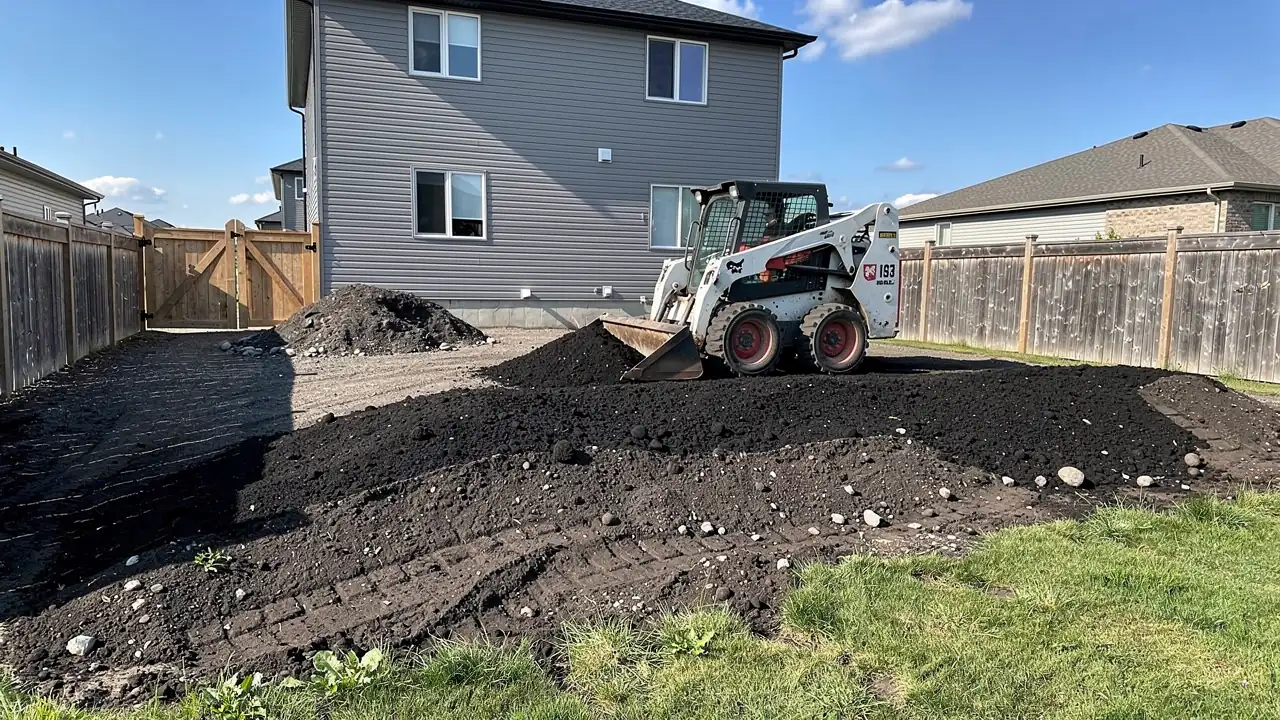


Skid steer grading backyard slope in Guelph

Grading and Levelling in Guelph for Lots, Yards and Job Sites

Guelph Excavation Pros is the grading contractor behind new homes that need a grading certificate, homeowners fighting wet basements or soggy yards, and builders who need a site shaped to plan. We move soil so water goes where it should: away from foundations, along swales and off the lot without flooding the neighbours.

What you get is a lot graded to the approved elevations, compacted so it holds its shape and topsoiled ready for sod or hydroseed. On existing homes, yard regrading reverses the slow settling that tips ground back toward the walls.

We set grades with a rotating laser on every job and have done so across 10+ years and 500+ projects. Lot grading is precise work, because a few centimetres often decide whether water drains or sits.

Our Grading and Levelling Services in Guelph

Our grading and levelling work covers five job types, from a full new-build lot to a single level pad for a garden shed. Most yard drainage solutions combine a regrade with one or two swales.

Lot Grading for New Homes

New houses in Guelph are built to a lot grading plan approved with the building permit, showing finished elevations at the house corners, the swales and the lot lines. We grade to those numbers so the surveyor's check passes the first time.

Many of these lots come to us already cleared and rough graded by our site preparation and land clearing crew, which keeps the elevations consistent from start to finish.


Yard Regrading to Fix Drainage

Backfill around a foundation keeps settling for years, and window wells, gardens and old patios add their own low spots. Regrading builds the ground back up with compacted fill so it falls away from the house again.

Swales and Surface Drainage

A swale is a shallow, grassed channel that carries water along a side yard or rear lot line to the street or a rear-yard catch basin. We shape each one to a steady fall, usually at least 2%, so water keeps moving instead of pooling halfway along.

Where water has to go underground instead, our storm line excavation crew can connect a catch basin or a buried downspout line.

Topsoil Spread and Final Grade

Final grade means a layer of topsoil, screened free of stones and roots, spread 100 to 150 mm (4 to 6 in) deep and fine-raked to the design elevations. It leaves a smooth, firm surface ready for sod or hydroseed.

Levelling for Patios, Sheds and Play Areas

Small flat areas need tight tolerances to look right. We strip, level and compact pads for sheds, patios, hot tubs and play structures to within about 10 mm (3/8 in), with a slight cross-fall so they shed rain.

Signs Your Lot Is Graded Wrong

The clearest sign of bad grading is water standing against your foundation after a rain. If the ground beside the house is flat or tilts toward the walls, every storm delivers water right where the basement can soak it up.

  • Puddles or soft ground within 1.5 m (5 ft) of the foundation a day after rain
  • Damp basement walls, white efflorescence or water at the wall and floor joint after storms
  • Soggy lawn areas that stay wet well into spring
  • Mulch, soil or stone washing onto patios, walkways or the driveway
  • Downspouts emptying onto ground that slopes back toward the house
  • Soil or mulch piled against the siding or covering the brick weep holes

Several of these signs together usually point to grading rather than a failed foundation. We confirm it by shooting elevations around the house, which tells us within an hour whether a regrade will solve the problem.

Grading faults show up quickly on Guelph clay because water soaks in slowly and lingers at the surface. A slope that would be fine on sand can leave clay saturated against the walls for days.

Regraded soil sloping away from Guelph house

How Much Slope a Lot Needs

Ground should fall at least 15 cm over the first 3 m from the house (6 in over 10 ft), a 5% slope. Beyond that zone, lawns need about 2% to keep water moving toward swales and the street.

The Ontario Building Code requires a building site to be graded so water does not collect at or near the building and does not adversely affect neighbouring properties. City of Guelph grading plans set the exact elevations for new lots, and the targets below are what we build to on regrades.

Typical slope targets for residential lots
AreaTarget slopeWhy
First 1.5 to 3 m (5 to 10 ft) from the foundation5% minimum, about 15 cm over 3 mMoves roof and surface water away before it soaks down along the walls
Lawns and yards2% to 5%Keeps water moving without making the lawn awkward to mow or use
Swales2% minimum along the channelPrevents standing water and soft spots in the swale bottom
Driveways2% minimum toward the streetSheds water away from the garage slab and door
Patios and pads1% to 2% away from the houseSheds rain while still feeling flat underfoot
Banks and slopesNo steeper than 3:1 (33%)Stays stable and can be mowed safely

We also keep finished grade at least 150 mm (6 in) below siding and below brick weep holes. When grade has crept up over the years, regrading means cutting soil away from the wall, not just adding more.

Some yards cannot fit these slopes in the space available, especially narrow lots that climb toward the back fence. In those cases a short retaining wall holds the difference and gives the lawn room to drain properly.

Grading Methods: Laser, GPS and Hand Finish

We choose between three grading methods based on site size and the accuracy required. Laser grading handles most residential lots, GPS machine control suits large sites with a digital design, and hand finishing produces the final surface for sod.

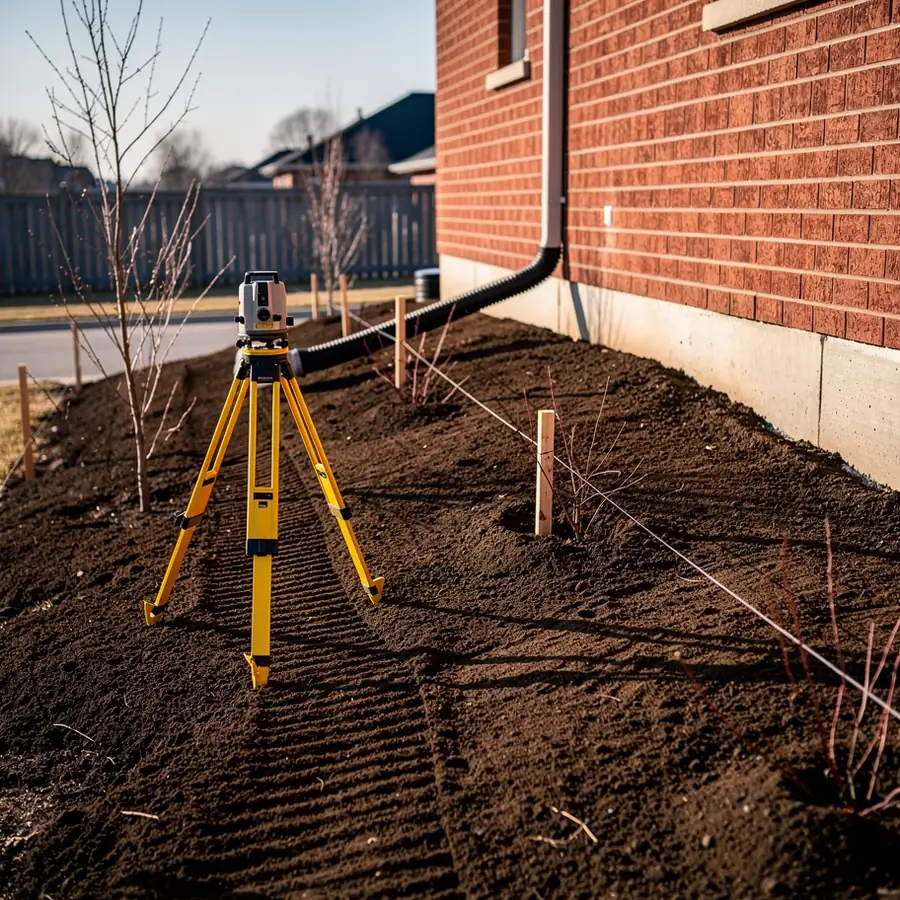
Laser grading. A rotating laser on a tripod sends out a level reference beam, and a receiver on the machine or a grade rod reads height to within about 6 to 10 mm (1/4 to 3/8 in). It is our everyday tool for regrades, new-home lots and pads.

GPS machine control. On larger commercial or subdivision sites, a GPS receiver on the machine compares its blade or bucket position with a 3D model of the grading plan. It holds roughly 15 to 30 mm (5/8 to 1 1/4 in) across several acres without a forest of grade stakes.

Hand finish. The final pass uses landscape rakes and a skid steer grading attachment to smooth ridges and pick stone out of the topsoil. It cannot set elevations by itself, but it decides how good the lawn looks for years.

Our Grading Process

Our grading process has five steps, and the measuring at the start matters as much as the machine work. Most residential regrades take one to three days, plus the sod or seed.

  1. Elevation Survey

    We shoot existing grades around the house and across the yard with a laser or survey level, then compare them with the approved grading plan if one exists. You get a marked-up sketch showing where soil comes off and where it goes on.

  2. Cut and Fill

    Soil is cut from the high areas and moved to the low ones, and imported fill is added only when the lot comes up short. For bigger moves, our earthmoving and soil removal service supplies or removes the difference.

  3. Compaction

    Fill is placed 150 to 200 mm (6 to 8 in) at a time, and each layer is rolled or plate-compacted before the next goes on. Uncompacted fill settles, and settled fill beside a house recreates the original problem within a couple of seasons.

  4. Topsoil and Seed or Sod

    We spread 100 to 150 mm of screened topsoil and finish with sod or hydroseed. Sod gives an instant lawn, while hydroseed costs much less but needs four to eight weeks of regular watering to fill in.

  5. Grading Certificate Support

    On new homes, an Ontario Land Surveyor or engineer certifies that finished grades match the approved plan before the City signs off and releases any grading deposit. We work alongside your surveyor, correct any point that falls outside tolerance and keep the file moving on the City's timeline.

Guelph Grading Rules and Your Neighbours

In Guelph, changing grade or bringing in fill can require a permit under the City of Guelph Site Alteration By-law. The by-law exists to stop fill dumping, erosion and drainage changes that harm other properties.

Infill houses need a grading and drainage plan with the building permit application, as listed in the City's infill house permit checklist. That plan fixes the elevations we grade to and shows where water must leave the lot.

Whatever the permit status, a regrade cannot send more water onto a neighbouring lot than before. We keep existing drainage patterns at the property line and talk through any neighbour concerns with you before work starts.

Just outside the city, the Township of Guelph/Eramosa requires a site alteration permit for grade changes of more than 10 cm, according to its site alteration guide. Lots that back onto a creek or wetland may also need a GRCA permit under O. Reg. 41/24.

Grading Cost in Guelph

Most residential yard regrading in Guelph costs $2,500 to $8,000, and full lot grading for a new home usually runs $5,000 to $15,000 including topsoil. Small level pads for sheds or patios often come in at $800 to $2,500.

We give a fixed written quote after the elevation survey, so the price reflects your actual grades rather than a guess.

Grading cost drivers
Cost driverWhat it involvesTypical range
Area gradedMachine time scales with the square metres reshaped$2 to $6 per sq ft for typical regrades
Fill importClean fill or screened topsoil trucked in when the lot is shortTopsoil $35 to $60 per m³ delivered; clean fill less
AccessNarrow side yards mean a compact track loader and more hoursAdds 15 to 40%
Sod or seedFinishing the graded areaSod $1.25 to $2.25 per sq ft installed; hydroseed $0.20 to $0.40 per sq ft
RemovalsOld patios, gardens, shrubs or concrete sitting in the wayQuoted per item or by the hour

Regrading in late spring or early fall usually costs less overall. The soil is workable, and sod or seed establishes with far less watering than in July heat.

Our Regrade Guarantee

If water still pools in the area we regraded once the agreed work is finished, we come back and correct it. That promise is written into every regrade quote, along with the area covered and the conditions.

The guarantee applies to surface water in the regraded zone, measured against the slopes we agreed to build. It does not cover water arriving from outside the work area, a downspout later moved, new landscaping that changes the grade or groundwater rising through the basement floor.

We can offer it because we survey before and after. You receive both sets of elevations with your invoice, so there is a clear record of exactly what was built.

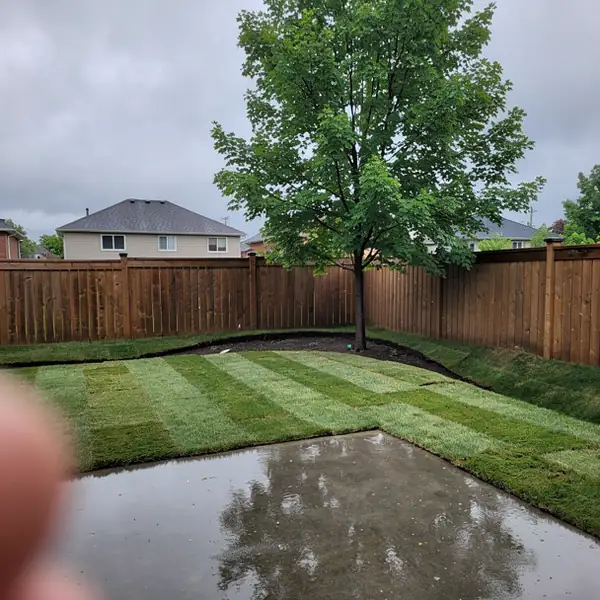
New sod on regraded yard after rain

Lot Grading FAQs

These are the grading questions Guelph homeowners ask us most, with the short answer first.

What is lot grading?

Lot grading is shaping the ground on a property so surface water flows away from buildings and off the lot along a planned route. It sets the elevations of the yard, swales and driveway relative to the house and the lot lines.

Do I need a permit to regrade my yard in Guelph?

You may, if the work brings in or removes fill or changes grade in a way the City's Site Alteration By-law covers. Minor regrades that restore the original slope beside a house often fall below that threshold, and we confirm with the City before starting any job that is close.

How can I tell which way my yard slopes?

Push one stake into the ground against the foundation and a second 3 m (10 ft) out, then tie a string to the first stake at ground level. Level the string with a line level and measure down to the ground at the second stake: 15 cm (6 in) or more is good, and anything less means the slope needs work.

Hydroseed or sod after grading?

Sod costs roughly five to eight times as much as hydroseed but gives a usable lawn in two to three weeks. Hydroseed is the budget choice for large areas, works best from mid-August to late September or in spring, and needs regular watering for four to eight weeks.

Can regrading fix a wet basement?

Often, when the water comes from surface runoff collecting against the walls. It will not fix a high water table, failed weeping tile or foundation cracks, and in those cases our basement excavation crew can dig down to the footing for waterproofing and new drainage.

Grading Work Across Guelph and Wellington County

We grade lots and yards in Guelph, the surrounding Wellington County townships and nearby cities, and the soil changes how each job is built. Heavy clay in Milton holds water at the surface, while the sandy Waterloo Moraine under parts of Kitchener and Waterloo drains fast but erodes easily.

Guelph

Guelph's clay-loam over glacial till drains slowly, so regrades here depend on steady slopes and well-shaped swales. Learn about our grading and excavation in Guelph.

Puslinch

Rural Puslinch homes on septic need grading that keeps runoff off the leaching bed as well as away from the house. See our Puslinch grading and excavation page.

Milton

Milton's heavy clay and newer subdivisions with engineered lot grading plans make certificate-ready grading a common request. Find out about grading and excavation in Milton.

Book a Grading Assessment

Photos taken during or right after a rain tell us more than anything else, so send a few when you get in touch. We follow up with a site visit, an elevation check and a fixed written quote, and you can call or text 548-918-0387 seven days a week.

  • Photos or a short video of where water pools after rain
  • Where each downspout discharges
  • Any grading plan or survey for the property
  • Notes on basement leaks: where they appear and after what kind of rain
  • How you want the yard finished: sod, seed, patio or garden beds

Open Monday to Saturday 6:00am to 9:00pm and Sunday 9:00am to 9:00pm.

Call 548-918-0387Free Quote